
We rewrote our YouTube SEO guide for AI search: where AI Overviews and Perplexity read your video, which engines cite YouTube, and the eight steps we use on our own channel.
5,094 views
YouTube SEO in 2026: How to Get Your Videos Cited by AI
In our sample of six US “how to” searches, 12 of the 23 sources Google AI Overviews cited were YouTube videos. That is 52%. Four of those links even jumped to a timestamp, sending the searcher to the exact minute where the answer starts.
So the question for 2026 is not only “how do I rank on YouTube?” It is “how do I get my video picked as the source when an AI answers the question?” The good news: AI does not watch your video. It reads the text around it. That part is in your hands.
This guide is built on our own counts, the 2026 research we trust, and what we do on our own channel every week.
Short answer: to get your videos cited by AI search
- Make 5 to 20 minute videos that answer one question. Long-form gets 94% of YouTube citations.
- Fix the auto-generated transcript before you publish. Google AI Mode builds some answers straight from it.
- Write a long, specific description, and name your brand in it.
- Add chapters that start at 00:00 and read like questions.
- Refresh your best videos every 90 days. Citations can drop by half in a month.
Table of contents
What we counted
We pulled the AI Overview sources for 13 tutorial-style searches, most of them about SEO and digital marketing, with Semrush, six in the US and seven in Turkey, where our agency is based. In the US, YouTube supplied 12 of 23 sources. In Turkey, zero of 23.
| Country | Queries | AI Overview sources | YouTube videos | Video share |
|---|---|---|---|---|
| US | 6 | 23 | 12 | 52% |
| Turkey | 7 | 23 | 0 | 0% |
The US side is the story for most readers of this guide: for “how to” questions, Google already treats video as a primary source. Two of the six queries (“how to rank youtube videos” and “how to make sourdough bread”) cited only videos.
Our Turkish sample is small, and that zero is about the topic, not the country. When we looked at youtube.com in Semrush’s Turkey database (Oct. 24, 2026), YouTube was an AI Overview source for plenty of Turkish recipe, game and health searches. Turkish SEO and marketing questions are where AI Overviews still skips video, often citing machine-translated English pages instead. If you publish expert content in more than one language, that gap is an opening.
Limits: One day, desktop, not personalized. What you see may differ. Read it as a direction, not a precise rate.
AI reads your video. It does not watch it.
When an AI engine cites a video, it is working from text: the transcript, the description and the chapter titles. Three 2026 studies point to the same three fields.
- Transcript. Peec AI’s analysis of 30 million sources (March 2026) found Google AI Mode building some answers straight from a video’s auto-generated transcript. If the captions misheard your brand name, the AI reads the wrong name.
- Description. Peec found other answers built from the description. Scrunch saw that the lift in sponsor mentions came from description text, not the voiceover. OtterlyAI measured a positive link between description length and repeat citation (r ≈ 0.31).
- Chapters. In OtterlyAI’s data, 31% of cited videos had chapters, and 78% of those were cited more than once. Timestamped citations showed up only on Google surfaces, which matches the four timestamped links in our sample.
One caveat: OtterlyAI studied videos that were already cited. These findings explain repeat citation better than first-time selection. Correlation, not proof.
Which engines cite YouTube?
Google, mostly. Perplexity shows videos but now rarely cites them. ChatGPT almost never does.
| Engine | Share of YouTube citations |
|---|---|
| Perplexity | 38.7% |
| Google AI Overviews | 36.6% |
| Google AI Mode | 19.6% |
| ChatGPT | 4.4% |
Source: OtterlyAI, YouTube Citation Study 2026, 100M+ citations.
We tested Perplexity ourselves. The table above is March 2026 data. On Oct. 24, 2026, we ran 10 of our test queries (six US, four Turkish) in Perplexity by hand, on a free account from Istanbul. In six of the 10 answers, Perplexity added a separate block of 8 to 12 YouTube videos next to the answer. But in the answer text itself, it cited YouTube only once, for a Turkish YouTube SEO query. Scrunch also reports that Perplexity has barely cited YouTube since mid-August 2026. So Perplexity may show your video on screen, but it now builds the answer mostly from web pages.
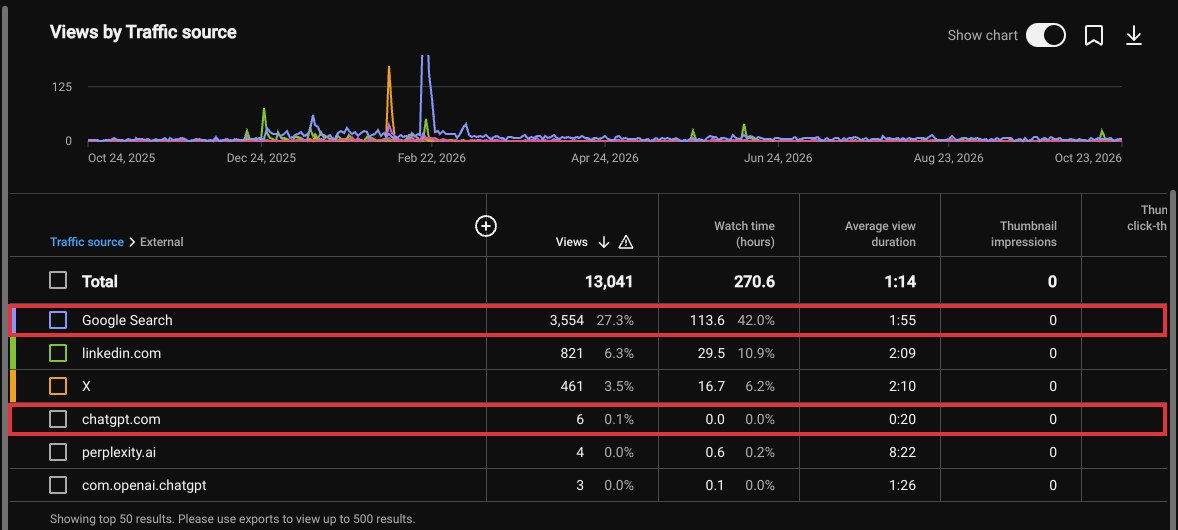
Our own channel tells the same story. Over the past year, views on our channel coming from ChatGPT fell from 46 to 6, while views from Google Search rose 72%, from 2,071 to 3,553 (YouTube Analytics, external traffic, Oct. 2024 to Oct. 2026).
Citations fade fast
Meltwater’s September 2026 report shows YouTube still the most-cited source in AI Mode, AI Overviews and Gemini, yet its citation volume fell 57.3% in a single month. Scrunch saw sponsored videos’ citation rate drop from 18.4% to 10.5% within a month. New videos push old ones out. Video GEO is maintenance, not a one-time task.
Other people’s channels count too
In Ahrefs’ study of 75,000 brands, YouTube mentions were the factor most strongly linked to AI visibility (correlation about 0.737). Showing up as a guest on someone else’s channel can matter as much as your own upload.
Eight steps we use on our own channel
1. Check the query in two places
Every video should answer one question, and that question lives in two search engines.
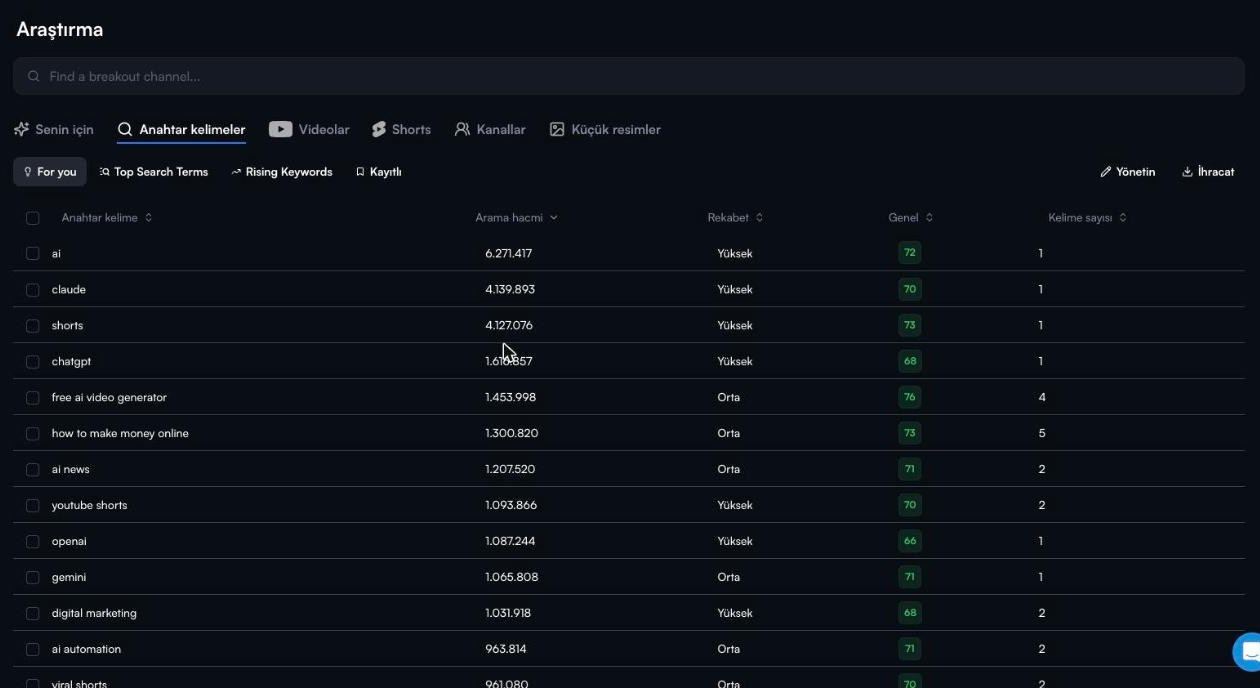
- YouTube side: vidIQ. The keyword research screen shows search volume, competition and related terms on YouTube. We use it every week to grow the channel, refresh older videos and get title ideas without starting from scratch.
- Google side: Semrush. We check whether the same query triggers an AI Overview and who it cites. Our 13-query test above came from Semrush data.

2. Script it to be quoted
- Give the answer in the first 30 seconds. The first paragraph of the transcript may be the one AI quotes.
- Say each number with its source: “According to Ahrefs’ study of 75,000 brands…” A number without a source is not a quotable sentence.
- Say brand, tool and people names clearly. Auto-captions spell what they hear.
- Aim for 5 to 20 minutes. In OtterlyAI’s data, 10-20 minute videos took 32.1% of citations and 5-10 minute videos 26.1%. Shorts took 5.7%.
3. Fix the transcript
Open Subtitles in YouTube Studio and correct brand names, numbers and technical terms. Our videos also carry a second audio track in English, which puts the same video in front of a second market.
4. Write the description like a short article
- Answer the question in the first two lines, in plain sentences.
- Follow with a short summary, the tools you mention and source links.
- Name your brand in the text, not only in the voiceover.
- Two or three topic hashtags are enough.
- Keep links short and without UTM tags. GA4 already shows YouTube traffic as a youtube.com referral.
5. Name chapters like questions
Add at least three chapters, starting at 00:00, each at least 10 seconds long. Use “Where does AI Overviews read a video?” instead of “Intro” and “Part 2.” vidIQ drafts the chapters; we rewrite the titles as questions.
6. Title and thumbnail
Match the title to the words people actually search. We compare two or three options with vidIQ’s title score. We make thumbnails and supporting video elements (B-roll, short transitions, diagrams) with Higgsfield, and we check every rendered letter, since AI image tools still mangle text.
7. Connect the video to your site
Embed the video in the article on the same topic and add VideoObject schema (name, description, uploadDate, thumbnailUrl, duration; Clip for chapters). Publish an edited summary of the transcript on the page. ChatGPT rarely cites YouTube, so your site’s text does that job there. This page is an example of the step.
A note on tags and old habits
YouTube itself says tags play a minimal role in discovery. Use a few for commonly misspelled names and spend the time on the transcript instead. Custom thumbnails, clear titles and playlists still matter as much as they did in 2020.
8. Refresh every 90 days
Update the description, chapters and pinned comment on your top 10 videos every quarter. In OtterlyAI’s data, recency was linked to repeat citation (r ≈ 0.30).
The vidIQ, Semrush and Higgsfield links are affiliate links. Stradiji may earn a commission at no extra cost to you. We only recommend tools we use.
Turning video into a lead magnet
A video does not bring clients by itself. A path from the video to the next step does. Ours has four steps:
- Discovery. The video is found on YouTube, on Google and in AI answers.
- One link. The first line of the description points to one related guide or checklist. One link, not five.
- Form. The viewer leaves a name and email to get a guide or checklist and lands in our CRM with the channel they came from.
- Relationship. The weekly newsletter and videos build trust. Calls follow.
“I have published a newsletter and a video every week since April 2020. A large share of our consulting inquiries comes from those two channels.” Mert Erkal
Citations do not guarantee clicks. In Pew Research’s study of 900 US adults (July 2025), people clicked a result in 8% of visits with an AI summary and 15% without one. That is why the job of a video is trust and first contact, not traffic. Step 3 turns that contact into a record.
Get this guide as a PDF: the Video GEO Checklist
We turned this guide into a 24-point checklist. Each point is backed by a study or by data from our own channel, and we update it every week. Leave your name and email, and the PDF opens right away. We’ll email you a copy, too.
Measuring AI traffic in YouTube Studio
YouTube Studio has no “AI” source, but AI referrals show up by site name. Once a month:
- Open Analytics › Content in YouTube Studio.
- In Traffic source types, click External.
- Look for chatgpt.com, perplexity.ai and gemini.google.com, and expand the list to see all rows.
- Log the numbers. Citations shift within a month, so watch the trend.
Google traffic arrives as one line that mixes classic results, video carousels and AI Overviews, so we also run our target queries by hand in AI Mode, AI Overviews and Perplexity each month and archive screenshots. For the site side, we use the free GEO funnel we built from Search Console and Bing Webmaster Tools.
New: Add your YouTube channel to Search Console
Since late July 2026, Search Console lets you add YouTube, X, TikTok and Instagram accounts as their own properties. Once your channel is in, you can see which Google queries lead to your videos, plus impressions, clicks, countries and devices. Google’s guide covers Search, Discover and News. It does not break out AI Overviews or AI Mode.
- In Search Console, open the add property screen and click Add next to YouTube.
- Verify with the Google account that owns the channel.
- In the Performance report, switch the search type between Web, Video and the new Multimodal option.
We added the @Stradiji channel on Oct. 24, 2026. The first data covers Oct. 23: 711 impressions, 3 clicks and 139 different queries in a single day. Almost all impressions came from the video block in regular Google results. Here is how we use the report:
- Don’t judge a single day. Data starts only one day before you add the channel. There is no history, so we wait for 28 days before reading trends.
- Find videos with impressions but no clicks. Our Claude Chrome tutorial got 151 impressions and 0 clicks in a day. Videos like that are first in line for a new title and thumbnail. Log each change with a Search Console annotation.
- Check which commercial queries show your videos. Ours appeared for “en iyi geo ajansı” (best GEO agency) and “geo hizmeti” (GEO services). Put a link to the matching service page in the first line of those descriptions.
- Catch spelling variants. People who typed “al modu” instead of “AI Modu” (AI Mode) still found our video. Keep variants out of the title; let them appear naturally in the transcript and description.
- Track Web and Video separately. Most impressions come from the video block in regular results. The Video tab is much smaller (50 impressions for us the same day).
- Line it up with your site’s Search Console data. If your page and your video both show for the same query, that is two doors, not cannibalization. Embed the video on that page.
- AI Overviews are not broken out here. Fill that gap with a tracking tool such as GeoGenie or with manual checks.
YouTube in our own tracking: GeoGenie and Bing
We track our US AI visibility with GeoGenie. From Oct. 18 to 24, 2026, across 142 answers to 25 GEO and SEO prompts, the most-cited domain was youtube.com: 18 answers, 15 different videos (13%). That put YouTube ahead of developers.google.com, LinkedIn and Reddit. Every one of those citations came from Google AI Overviews. On the same prompts, ChatGPT did not cite YouTube once.
Bing Webmaster Tools’ AI Performance report shows the site side. From July 24 to Oct. 21, 2026, Copilot cited stradiji.com 254 times across 34 pages. None of the top 25 cited pages is a video page; all are glossary entries or guides. In short, video wins on Google surfaces, and the text on your site wins in Copilot and ChatGPT. That is why we embed each video in the article on the same topic and publish a transcript summary on the page.
Want to know if your videos show up in AI answers?
Our GEO consulting measures which queries cite whom and builds a roadmap for your channel and site. Start with the free GEO Score Card to see where your site stands.
FAQ
What is YouTube SEO in 2026? YouTube SEO is the work on titles, descriptions, transcripts, chapters and your channel that helps a video get found on YouTube, on Google and now in AI answers. We call the AI part Video GEO.
Do YouTube tags still matter? Very little. YouTube says tags play a minimal role in discovery. Add a few for commonly misspelled names and put your effort into the transcript and description.
Do AI engines cite YouTube Shorts? Rarely. In OtterlyAI’s data, long-form videos took 94% of YouTube citations and Shorts 5.7%. Use Shorts for discovery and point viewers to the long video.
Can a small channel get cited? Yes. In OtterlyAI’s study, 40.8% of cited videos had fewer than 1,000 views, and views, likes and subscribers showed no link to citation.
Does ChatGPT cite YouTube videos? Very few. ChatGPT accounts for 4.4% of YouTube citations in OtterlyAI’s data, and on our own channel ChatGPT-referred views fell from 46 to 6 in a year. To show up in ChatGPT, publish the video’s topic as text on your site too.
What tools do you use? vidIQ for YouTube keywords, titles and channel analytics; Semrush for Google and AI Overview data; Higgsfield for images and video elements.
About the author
Mert Erkal is the founder of Stradiji. He has worked in SEO since 2009 and today advises companies in the US, UK, Australia and Turkey on SEO and GEO. He writes the weekly SEOs Diners Club newsletter and has published more than 700 videos on the Stradiji YouTube channel.
Sources
- Ahrefs: AI brand visibility correlations, 75,000 brands (Dec. 2025)
- OtterlyAI: The YouTube Citation Study 2026 (March 2026)
- Peec AI: Top domains cited by AI search, 30M sources (March 2026)
- Scrunch: YouTube influencers have an AI audience (2026)
- Meltwater: AI Search Visibility Report, September 2026 (Oct. 2026)
- Pew Research: Google users are less likely to click when an AI summary appears (July 2025)
- YouTube Help: Tags
- Stradiji: Semrush SERP analysis (13 queries, Oct. 22, 2026) and Stradiji YouTube channel analytics, external traffic (Oct. 2024 to Oct. 2026)
Related

These May Also Interest You


Make Stradiji a preferred source on Google
Google lets you pick the sources you want to see more of. Add Stradiji and our articles show up more often for you in search results and AI answers.
Add Stradiji on GoogleThe SEOs Diners Club
Every week, Mert Erkal breaks down what changed in SEO, GEO and AI search, backed by real tests and data. It's free.
Subscribe for freePopular Posts
The SEOs Diners Club · Weekly newsletter
Every Monday: what's actually moving in SEO and AI search
Mert Erkal breaks down one big shift each week, backed by real tests and data.
Free · 247 weekly issues since 2022 · Unsubscribe anytime
