
You can build an SEO tool in an afternoon. Can ChatGPT read it? We tested four tools we built with Claude. Here is the 2-minute check and what broke on mobile.
Your Vibe-Coded Tool Might Be Invisible to ChatGPT. Here’s the 2-Minute Test.
Summary
Vibe coding means describing what you want in plain English and letting AI write the code. In the last two months, we built four interactive tools on stradiji.com this way, mostly with Claude.
Building them was the easy part. The question we should have asked first: can ChatGPT, Claude and Perplexity actually read what we built? Most AI crawlers don’t run JavaScript, and most vibe coding platforms ship pages that need it.
We tested our own tools on Nov. 17, 2026. All four passed. One of them still broke on mobile, and a friend caught it before we did. Here is the test, the numbers and the five checks we now run before anything goes live.
Grab a coffee.
What is vibe coding?
Andrej Karpathy coined the term in February 2025. By the end of the year, Collins Dictionary named it Word of the Year. The idea: you stop reading code line by line. You say what you want, look at what comes back and ask for changes.
The tools fall into two camps:
- Prompt-to-app builders: Lovable, Bolt, v0, Google AI Studio. You type in a browser and get a working page in minutes.
- Agents that work in your files: Claude Code, Cursor, Claude Cowork. They work inside your existing site and folders.
The 2026 data tells a split story. Redwerk’s August 2026 report describes vibe coding as a mass-market way to create software and still a minority way to ship it. Starting is easy. Finishing at production quality is not.
The part nobody talks about: AI crawlers don’t run JavaScript
Here’s why this matters for your pipeline. A growing share of your buyers ask ChatGPT or Perplexity before they ever visit your site. To be named in those answers, the AI crawler has to be able to read your page.
Googlebot renders JavaScript. AI crawlers don’t.
- Vercel tested the major AI crawlers and verified that ChatGPT’s and Claude’s bots do not execute JavaScript. Content loaded by client-side JavaScript simply isn’t there for them.
- A joint Vercel and MERJ analysis of more than 500 million GPTBot fetches found zero evidence of JavaScript execution. The bot downloads the JS files. It never runs them.
- Lovable and Bolt produce client-side rendered React apps by default. When an AI bot requests the page, it gets a near-empty HTML shell: no headings, no copy, often no meta tags.
- Lovable added per-route server-side rendering as an option for new projects created after April 20, 2026. Helpful, but you have to know to turn it on.
This is the first of what we call the Three Doors of AI Visibility: Reach. If the bot can’t read you, it can’t recognize you or believe you. It’s also a good reminder that GEO sits on top of SEO. “Put your content in the HTML” has been a technical SEO rule for 15 years. It’s now the first rule of AI visibility too.
We tested our own tools
These are the four pages we built with Claude and Claude Cowork:
| Page | What it does |
|---|---|
| GEO Score Card | Scores a site’s AI visibility across 9 categories and 70 tasks |
| The Evolution of SEO: 35 Years of Search History | Interactive timeline, updated monthly |
| What Is Schema Markup? | Glossary guide with a live JSON-LD tester built in |
| AI Visibility for E-commerce: The 2026 Playbook | Form that sends a PDF guide and an optional newsletter signup |
It didn’t stop at tools. We moved stradiji.com from WP Engine to Hostinger with Claude, and the site went live on the new host on Nov. 1, 2026. We use Claude’s computer use and Claude in Chrome to work in wp-admin, the DNS panel and Search Console. We also connected Claude to HubSpot through its MCP connector. A free HubSpot account gave us a real CRM, and every form submission on the site now lands there as a lead. Today we run everything through Claude, from design and form flows to redirects, publishing and lead tracking, and we no longer need an outside developer.
Part of this came out of Britney Muller’s Actionable AI for Marketers course on Maven. I graduated from the October-November 2026 cohort, where Claude Cowork was the main tool. My course project was a one-page AI visibility snapshot that shows whether a brand gets cited in AI answers. The goal: cut a two-hour manual check we run for every new prospect down to 10 minutes.
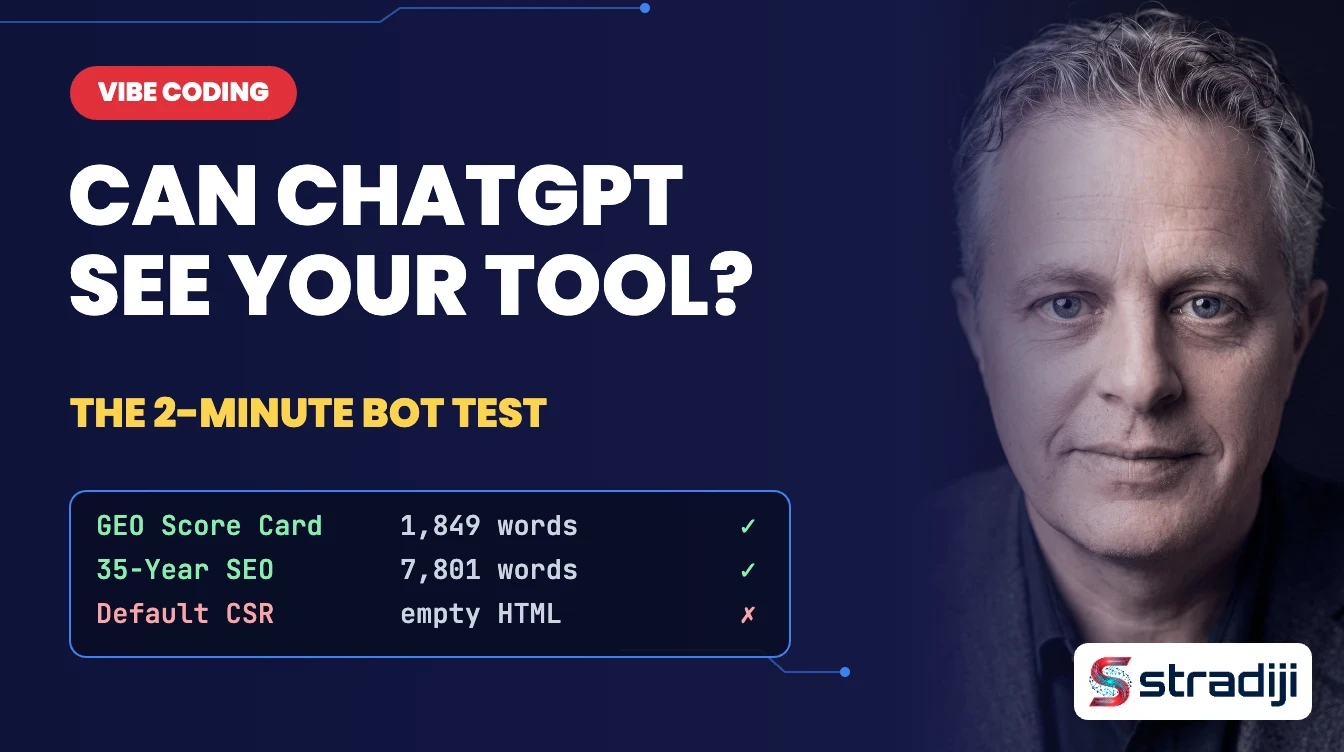
On Nov. 17, 2026, we requested each page without cookies or a logged-in session, stripped out scripts and styles, and counted the words left in the raw HTML. That is roughly what GPTBot sees.
| Page | Words in raw HTML |
|---|---|
| GEO Score Card (English) | 1,849 |
| GEO Score Card (Turkish) | 1,554 |
| The Evolution of SEO (Turkish) | 7,801 |
| GEO Roadmap (hand-built, for comparison) | 2,968 |
All of them pass. The reason: we didn’t build them as standalone apps. Each tool lives inside a WordPress page. The copy comes from the server as HTML, and JavaScript only handles the interactive parts like scoring, filtering and the schema tester.
Had we built the same tools from scratch in a prompt-to-app builder with default settings, the table would likely look very different.
The 2-minute test
- Open your tool’s page and copy its most important sentence.
- In Chrome, type
view-source:in front of the URL and hit Enter. - Press Cmd+F (Ctrl+F on Windows) and search for that sentence.
If it’s not there, ChatGPT can’t see it either. Prefer the terminal? curl -s -A "GPTBot" https://yoursite.com/tool/ | grep "that sentence"
Where we got it wrong: mobile and email
We built the page for our AI visibility playbook with Claude Cowork. Fill out the form, get a PDF, opt in to the newsletter if you want. I checked it on desktop. Everything looked right. We shipped it.
Then my friend Mehmet Emre Baş, an SEO consultant in Türkiye, sent me a screenshot from his phone. The checkbox labels were stacked on top of each other: the free scan opt-in, the newsletter opt-in and the privacy consent, all overlapping and unreadable. Right at the moment we were asking someone to trust us with their email.
The cause was small. The form plugin (Ninja Forms) gave each label a fixed height. One line on desktop became three or four lines on a phone and spilled over. We fixed it the same day with one line of CSS. We also found formatting shifts in the emails the form sends.
The lesson: when AI says “it works,” it’s right about the screen it checked. Don’t expect it to be flawless. It can’t see the screen you never looked at.
The security side is more serious:
- Veracode’s 2025 GenAI Code Security Report tested more than 100 language models. 45% of the generated code samples failed security tests. The code ran fine. It just left doors open.
- Lovable acknowledged that between Feb. 3 and April 20, 2026, any Lovable user with a project link could access the source code and chat history of public projects. Chat history means everything you told the AI.
Five checks before you ship a vibe-coded tool
- Raw HTML test. The 2-minute check above. If your key copy isn’t in the raw HTML, turn on server-side rendering or put the tool inside an existing page on your site.
- Someone else’s phone. Your desktop isn’t enough. Have at least one person test on a different phone, ideally with a larger font setting. That’s what saved our form.
- Email clients. If the tool sends email, open it in Gmail, Outlook and on a phone. HTML email doesn’t behave like a web page.
- Keys and personal data. Is an API key hardcoded? Where does form data go, and is your privacy notice in the right place? Did you paste anything sensitive into the AI chat?
- Schema and measurement. Does the page describe itself with structured data? Is the form submit tracked as a GA4 event and does it reach your CRM? If you don’t measure the tool, you can’t tell whether it earns its keep.
Our take
I’m not against vibe coding. It’s the most exciting shift I’ve seen since I started doing SEO in 2009. We don’t work with an outside developer anymore. That doesn’t mean the developer’s job disappeared. Testing, checking and owning the result is now my job. AI writes the code. You do the verification. Build, measure, fix, measure again.
The one thing to do this week
Pick the most valuable tool or calculator on your site and run the raw HTML test. Then see how the rest of your site looks to AI crawlers across nine categories.
FAQ
What is vibe coding?
Building software by describing what you want in plain language and letting AI write the code. Andrej Karpathy coined the term in February 2025.
Are vibe-coded websites good for SEO?
They can be, but usually not with default settings. Tools like Lovable and Bolt render content in the browser with JavaScript. Google can eventually read it. AI crawlers can’t.
Can ChatGPT read JavaScript content?
No. According to Vercel’s tests, ChatGPT’s and Claude’s crawlers don’t execute JavaScript. They read raw HTML only.
Which tools are used for vibe coding?
Prompt-to-app builders like Lovable, Bolt, v0 and Google AI Studio, and agents that work in your files like Claude Code, Cursor and Claude Cowork. We use Claude and Claude Cowork.
Is vibe coding secure?
Not on its own. In Veracode’s 2025 testing, 45% of AI-generated code samples failed security tests. Human review, security scanning and testing are still required.
Sources
- Vercel, How AI is changing SEO
- Blackalpaca, JavaScript Rendering and AI Crawlers (summary of the Vercel and MERJ analysis, June 11, 2026)
- Prerender.io, AI search visibility for vibe-coded sites
- 10Web, Lovable’s April 2026 SSR update
- Veracode 2025 GenAI Code Security Report (Security Today, Aug. 5, 2025)
- Lovable, Our response to the April 2026 incident (April 22, 2026)
- Redwerk, Vibe Coding Report 2026
- Hashnode, The state of vibe coding in 2026 (Karpathy and Collins Dictionary)
- Stradiji measurement: stradiji.com, Nov. 17, 2026, cookieless requests, word count after removing scripts and styles.

These May Also Interest You



Make Stradiji a preferred source on Google
Google lets you pick the sources you want to see more of. Add Stradiji and our articles show up more often for you in search results and AI answers.
Add Stradiji on GoogleThe SEOs Diners Club
Every week, Mert Erkal breaks down what changed in SEO, GEO and AI search, backed by real tests and data. It's free.
Subscribe for freePopular Posts
The SEOs Diners Club · Weekly newsletter
Every Monday: what's actually moving in SEO and AI search
Mert Erkal breaks down one big shift each week, backed by real tests and data.
Free · 247 weekly issues since 2022 · Unsubscribe anytime
