
AI traffic to US retail sites is set to grow 130% this holiday season. Our 12-point checklist shows if AI agents can reach, read and buy from your store.
Popular Posts
Latest Articles

AI Agent Readiness Checklist: 12 Checks Before Black Friday
The short version: AI agents now search, compare and check out for shoppers, and Adobe forecasts AI-driven traffic to US retail sites will grow 130% this holiday season. Walmart, Google and Amazon are each setting their own rules for agents. A mid-size store has none of those private channels, so readiness comes down to four questions: can agents reach your pages, read your products, trust what they read, and finish a purchase? This checklist covers all four in 12 checks, and each check takes less than 15 minutes to verify.
Why AI agent readiness matters before Black Friday
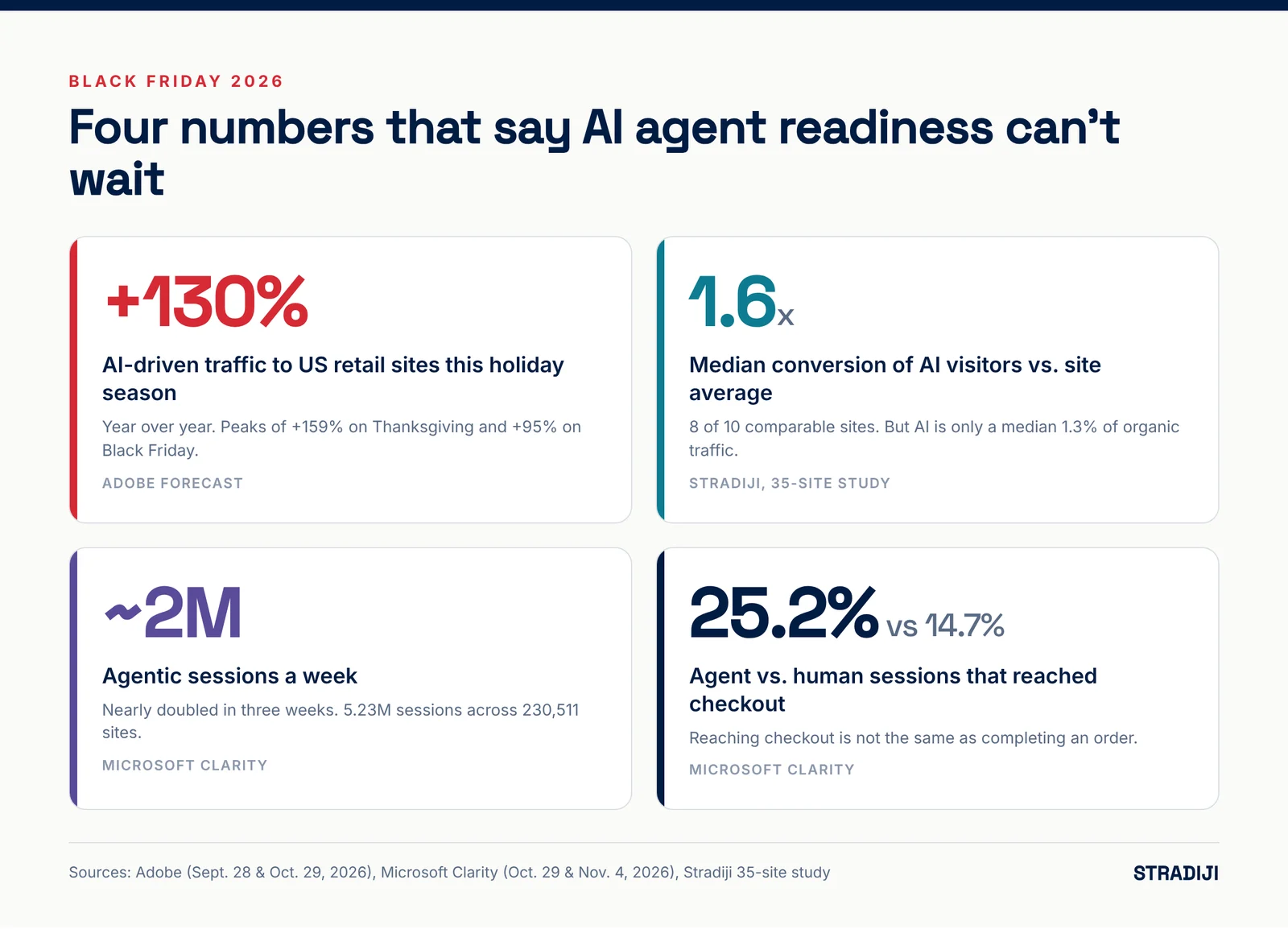
Four numbers explain why AI agent readiness can’t wait until January.
- +130%. Adobe forecasts AI-driven traffic to US retail sites will rise 130% year over year this holiday season, with peaks of +159% on Thanksgiving and +95% on Black Friday (Adobe, Sept. 28, 2026). In September, AI traffic to retail sites was up 71% year over year and converted 90% better than other traffic (Adobe, Oct. 29, 2026).
- 1.6x. Our own data points the same way. On 8 of the 10 sites in our 35-site study that had enough AI traffic to compare, AI visitors converted better than the site average, with a median of 1.6x. The catch: AI traffic was a median 1.3% of organic traffic (SEOs Diners Club #244). Small channel, high intent.
- ~2 million a week. Microsoft Clarity counted 5.23 million agentic sessions across 230,511 sites between August 13 and September 9. Weekly agent sessions nearly doubled in three weeks, to almost 2 million (Microsoft Clarity, Nov. 4, 2026).
- 25.2% vs 14.7%. In the same data, 25.2% of agentic sessions reached checkout, against 14.7% of human sessions (Microsoft Clarity, Oct. 29, 2026). Microsoft adds two caveats: reaching checkout is different from completing an order, and a person may take over mid-session. The direction is still clear. Agents come to buy.
What we found on 15 US retail sites
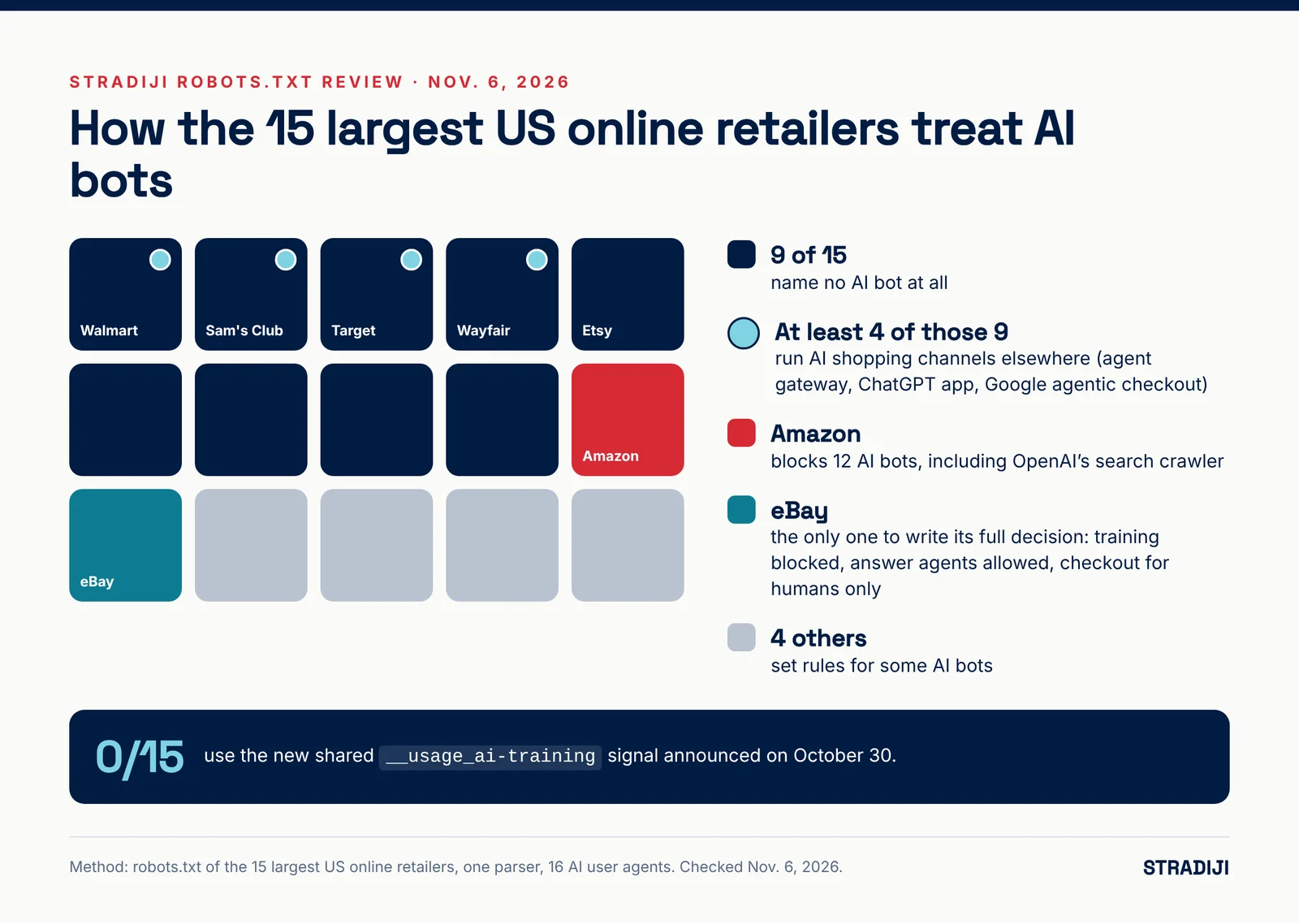
On November 6, we read the robots.txt files of the 15 largest US online retailers with the same parser, looking for 16 AI user agents.
- 9 of 15 don’t name a single AI bot. That includes Walmart, Target, Wayfair and Etsy.
- At least 4 of those 9 run AI shopping channels elsewhere: Walmart and Sam’s Club through Walmart’s MCP-based agent gateway (announced October 21), Target through its app in ChatGPT, Wayfair through Google’s agentic checkout.
- Amazon blocks 12 AI bots, including OpenAI’s search crawler, and keeps outside shopping agents off its site while it pushes its own assistant, Alexa for Shopping.
- eBay is the only one that writes its full decision into the file: training bots blocked, answer agents allowed, and the line “Checkouts are strictly for human users.”
- 0 of 15 use the new shared
__usage_ai-trainingsignal announced on October 30.
The lesson: big retailers now make their AI decisions in protocols and partnerships. Without a dedicated agent channel, your robots.txt, your firewall and your product data are the only doors agents walk through. Full data and method: SEOs Diners Club #246 / Dijital Pazarlama Notları #349.
The AI agent readiness checklist: 12 checks
We group the 12 checks into four doors. The first three come from the framework we use in our GEO consulting work, the Three Doors of AI Visibility: Reach, Recognize, Believe. Commerce adds a fourth door: Transact.
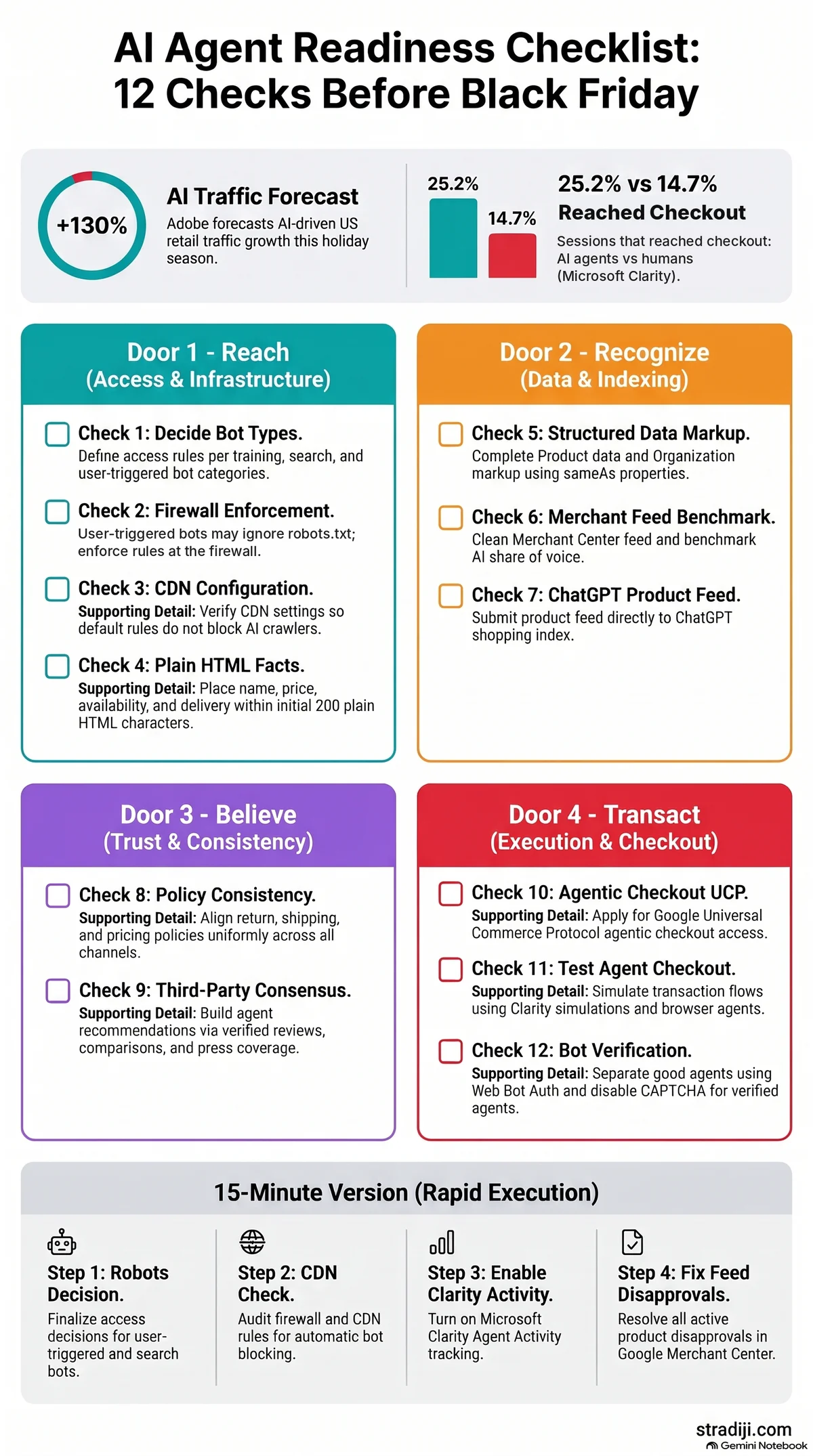
The whole checklist on one page. Save it or share it with your team.
Want the expanded version? Our free 18-page PDF adds a bot decision tree, a robots.txt template, a Clarity setup walkthrough and a prompt set you can copy. Get the playbook
Door 1: Reach. Can AI agents get to your pages?
1. Make a separate decision for each type of AI bot.
AI bots fall into three groups, and each group needs its own answer.
| Purpose | Bots | What blocking does |
|---|---|---|
| Model training | GPTBot, ClaudeBot, Google-Extended | Keeps your content out of future training data. Google says Google-Extended does not affect inclusion or ranking in Google Search. |
| Search and answers | OAI-SearchBot, Claude-SearchBot, PerplexityBot | Can remove you from AI answers. OpenAI says sites that opt out of OAI-SearchBot won’t appear in ChatGPT search answers. |
| User-triggered fetches | ChatGPT-User, Claude-User, Perplexity-User, Google-Agent | Fetches a page because a shopper asked for it. These are not automatic crawlers. |
Sources: OpenAI, Anthropic, Google, Perplexity.
How to check: Open yoursite.com/robots.txt and search for each name. If none appear, every bot is allowed by default. That’s good for visibility, as long as someone on your team chose it on purpose. Our recommendation for retail: open to search and answer bots, and a deliberate call on training bots. Stage 2 of our free GEO Roadmap walks through the same decision.
2. Treat robots.txt as a request.
User-triggered agents play by different rules. Google says its user-triggered fetchers, including Google-Agent, “generally ignore robots.txt rules.” Perplexity says the same about Perplexity-User, and OpenAI says robots.txt rules “may not apply” to ChatGPT-User. Robots.txt states your preference. It doesn’t enforce it.
How to check: List what you want to prevent (price scraping, bulk checkout attempts) and confirm each item is handled at the firewall or application level.
3. Check what your CDN or firewall does on its own.
Since July 1, 2025, Cloudflare asks every new domain whether to allow AI crawlers and blocks AI training crawlers by default on new domains (Cloudflare). Its managed robots.txt can also add AI rules to the top of your file (docs). A file that looks open can be closed in practice, and holiday security rules make that more likely.
How to check: In Cloudflare, open AI Crawl Control and review each bot’s status. On other CDNs, ask your team which bot rules are active, then confirm in server logs that OAI-SearchBot, Claude-SearchBot and PerplexityBot get 200 responses.
4. Put your key facts in the first 200 characters.
Agents often read a page in a hurry: the title, the first lines and whatever the page renders without scripts. If the first thing in your HTML is a cookie banner, a promo bar or an image with a long alt text, that’s what the agent reads first. Put the product name, price, availability and your strongest delivery or return promise at the top of the main content, in plain HTML. Google’s PageSpeed Insights now has an experimental Agentic Browsing section that flags pages agents struggle to read.
How to check: Open one product page with JavaScript turned off and read the first two lines of visible text. Then run it through PageSpeed Insights and look at the Agentic Browsing section.
Door 2: Recognize. Can AI agents read your products correctly?
5. Complete your product and Organization structured data.
Google’s merchant listing markup requires a product name, an image and an Offer with a price. GTIN is recommended, and for agents it’s often the field that ties your product to the one a shopper asked about. (We found GTINs on only 5 of 23 product pages in our US Shopify study.) Since September 2026, Google recommends store-wide return and shipping policies at the Organization level, with Offer-level markup only for exceptions (merchant listing, return policy, shipping). Add sameAs links from your Organization markup to your official profiles, so models connect your store to the reviews and mentions they find elsewhere.
How to check: Run three best-selling product pages through Google’s Rich Results Test. Look for price, availability, GTIN, return policy and shipping details. Then check your homepage for Organization markup with sameAs.
6. Clean up your Merchant Center feed and benchmark your AI share of voice.
Google’s agentic shopping surfaces draw on Merchant Center. Since September 2026, Merchant Center’s AI performance insights show your share of voice in AI Mode and AI Overviews against competitors, for English queries in the US, Australia, Canada, India and New Zealand (Google). When your markup and your Merchant Center settings disagree, Google uses the settings.
How to check: Open Merchant Center, fix disapproved items first, add missing GTINs and write down your current AI share of voice as a pre-season benchmark.
7. Get your products into ChatGPT shopping.
OpenAI has moved away from a standalone Instant Checkout. Shoppers now discover products in ChatGPT and buy on the merchant’s own site, with no fees. Merchants apply with a product feed; Shopify and Etsy sellers are already integrated. Shopping is live for US users (OpenAI). Required feed fields include item ID, title, description, URL, brand, seller name, image URL, availability and price (feed spec). One more thing: ChatGPT runs its own search index, so a healthy Bing listing helps Copilot but doesn’t guarantee ChatGPT visibility.
How to check: If you’re not on Shopify or Etsy, compare your Google feed with OpenAI’s required fields. Most of the work is already done.
Door 3: Believe. Do AI agents trust what they read?
8. Make your policies identical everywhere.
AI shopping agents compare. If your returns page says 30 days, your product page says 14 and Merchant Center says 60, you’ve given an agent three reasons to hesitate. The same goes for shipping costs, warranty and price.
How to check: Put the return window, shipping cost and support contact for one product side by side from four places: product page, policy page, structured data and Merchant Center.
9. Remember that a citation is not a recommendation.
When we asked AI models for the best GEO agency, they cited agency pages that ranked themselves first, then recommended someone else (SEOs Diners Club #242). Recommendations follow consensus across third-party sources: reviews, comparisons, press and forums. So there are two games. Getting onto a model’s shortlist is won off your site, through what others write about you, and it moves slowly. Getting cited is won on your site, through clear, crawlable pages, and it can move in weeks. Before Black Friday, the fastest off-site win is usually your review profile on the platforms your category relies on.
How to check: We score these separately for clients. Ask ChatGPT, Gemini and Perplexity “What’s the best store for [your category] for [your key use case]?” five times each in new chats, once with web search on and once with it off. Without search, you see what the model remembers. With search, you see who it cites.
Door 4: Transact. Can an AI agent finish the purchase?
10. Decide whether to apply for Google’s agentic checkout.
Google’s Universal Commerce Protocol (UCP) lets eligible merchants show a Buy button in AI Mode and the Gemini app. It’s rolling out in the US, with Australia and Canada expected early next year. Access requires an interest form, a technical build and selection by Google. You’ll need a Merchant Center account in good standing, a returns policy and support contact set in Merchant Center, and a payment provider that can process Google Pay tokens. Subscriptions, pre-orders, personalized, age-restricted and digital items are excluded (UCP docs, FAQ).
How to check: It won’t be live for most stores before Black Friday. Submit the interest form now and use the requirements as your 2027 to-do list.
11. Test whether an AI agent can actually check out.
Clarity’s simulation assessments test whether an agent can complete a task such as a purchase and report the time taken, the number of interactions and where it got stuck. Microsoft is starting with commerce and travel scenarios. Common blockers: pop-ups that hide the cart, forced account creation and promo fields that break the flow. The accessibility tree matters here too, because it’s what an agent reads to find buttons and form fields.
How to check: Run a Clarity simulation on your best-selling product. Then try the same purchase with a browser agent and note every step where it hesitates.
12. Separate good agents from bad bots.
Blocking all automation can also block shoppers’ AI agents. Cloudflare’s signed agents program uses Web Bot Auth, a cryptographic signature, to identify legitimate agents; the first group included OpenAI’s ChatGPT agent (Cloudflare). Google says it’s experimenting with Web Bot Auth for its own agents. Meanwhile, HUMAN reports traffic from AI agents and agentic browsers grew 7,851% in 2025 (HUMAN), and retail stays a top target for scraping.
How to check: Ask your security team whether your bot rules tell verified or signed agents apart from unknown automation, and whether those agents hit a CAPTCHA in checkout.
How to measure AI agent readiness
A checklist tells you what to fix. Measurement tells you whether it worked. We use four free sources and one rule.
- Microsoft Clarity. Bot Activity shows which bots request your pages once you connect a CDN (Cloudflare, Fastly, CloudFront, Akamai or Azure Front Door; the WordPress plugin connects automatically) (Clarity). Agent Activity shows which agents from OpenAI, Google and Anthropic visit and what they do: searches, form submissions, logins, bookings and checkout. The Citations report shows when AI assistants cite your site.
- Google Search Console and Bing Webmaster Tools together. Search Console’s generative AI report shows how often your pages appear in AI Overviews and AI Mode. Bing’s AI Performance report shows Copilot citations and the grounding queries behind them. Lined up over the same three months, they answer four questions: are we searched, do we make it into AI answers, how much of the answer is ours, and does it pay off? On our own site, 31% of Copilot citations came from queries that barely show up in Search Console (SEOs Diners Club #243). Keyword tools show zero volume for that demand.
- Prompt tracking. For clients we track a fixed prompt set in GeoGenie across ChatGPT, Gemini, Google AI Overviews, Copilot and Perplexity. Three rules keep the numbers honest: write prompts the way a shopper would, without your brand name; mix broad category prompts with specific use-case prompts; and read each engine on its own, since one average hides five different stories.
- Expect a delay. The order is almost always bots first, citations second, human visitors last. If you fix your robots.txt today, don’t judge the result by next week’s sales.
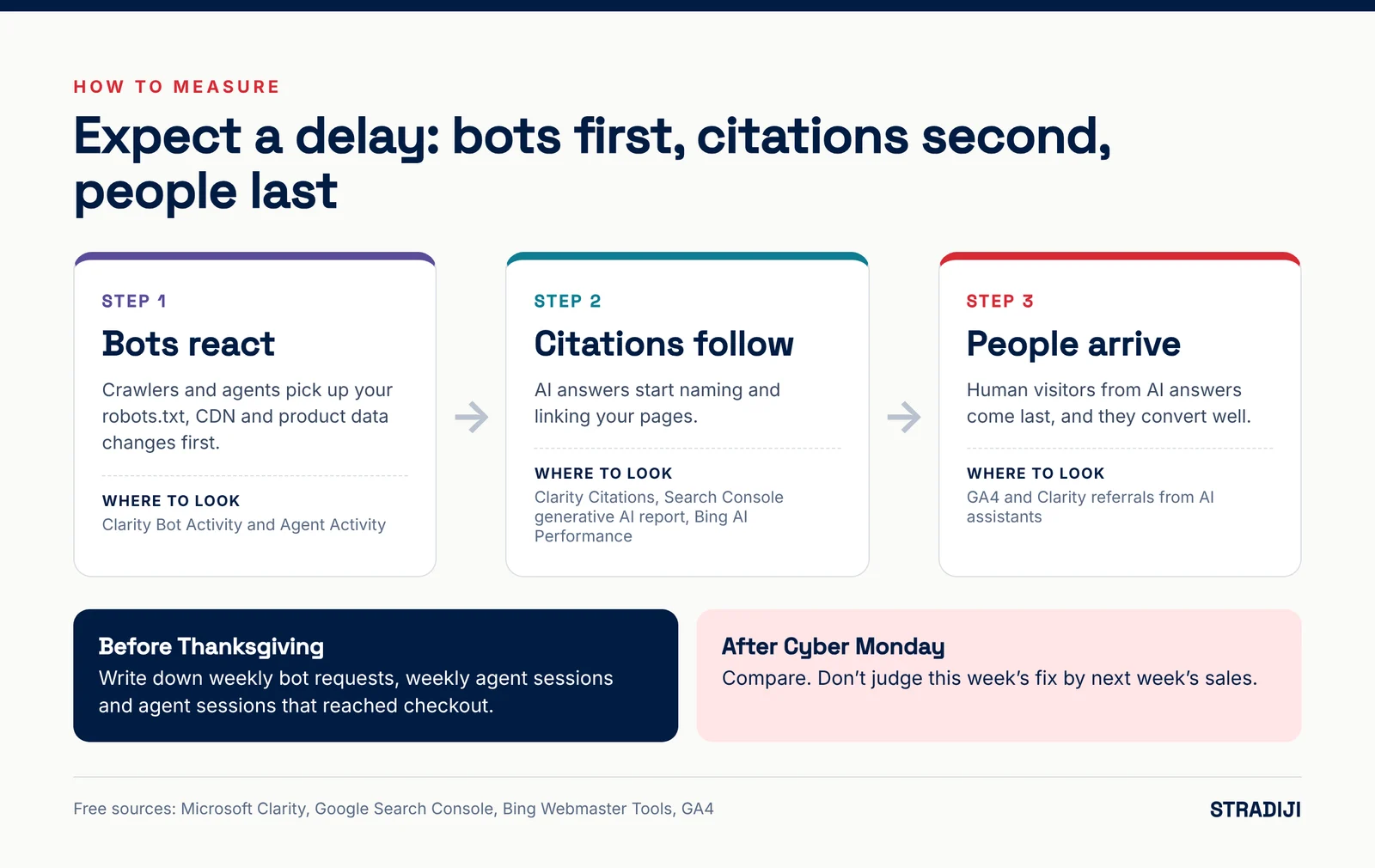
How to check: Turn on Clarity’s Bot Activity and Agent Activity this week, so you have a baseline before Thanksgiving.
What can wait until after the holidays
- The new
__usage_ai-trainingsignal. Anthropic honors it now, OpenAI “in the coming months,” Microsoft from February 2027 and Google in early 2027. It only covers training, so it won’t change your visibility this season. - llms.txt. Google says Search ignores these files: they “won’t harm (nor help)” (Google). OpenAI and Anthropic haven’t published official support. It can wait.
The 15-minute version
If you only have 15 minutes this week:
- Open your robots.txt and make a deliberate decision for training, search and user-triggered bots (check 1).
- Confirm your CDN isn’t blocking search and answer bots (check 3).
- Turn on Clarity’s Bot Activity and Agent Activity (measurement section).
- Fix the top disapproved items in Merchant Center (check 6).
Update log
- 9 November 2026: First version. Sources checked on this date. We’ll revisit after Cyber Monday with what changed in Clarity’s agent data.
FAQ
Will blocking GPTBot remove my store from ChatGPT?
No. GPTBot is OpenAI’s training crawler. Visibility in ChatGPT search depends on OAI-SearchBot, and user requests use ChatGPT-User (OpenAI).
Does a silent robots.txt hurt me?
No. A file with no AI rules allows every bot by default. The bigger risks are a firewall that blocks agents without anyone knowing and a checkout that agents can’t finish.
Do I need a deal with OpenAI or Google to appear in AI shopping?
No. ChatGPT shopping accepts merchant feeds, and Google’s AI surfaces draw on Merchant Center. Partnerships like Walmart’s agent gateway are extra channels. You can be visible without one.
How long until changes show up in AI answers?
Usually weeks. Crawlers pick up changes first, citations follow, and human visitors from AI come last. That’s why a baseline before Thanksgiving matters more than a perfect score.
Want the full playbook? Our free 18-page guide, AI Visibility for E-commerce: The 2026 Playbook, expands this checklist with a bot decision tree, a robots.txt template, a Clarity setup walkthrough, a prompt set you can copy, a 30-day plan and how we measure AI visibility for clients. Download the PDF
Prefer to see where you stand first? Request a free AI Visibility Snapshot: we run five buyer prompts across three AI engines and send you the screenshots within three business days.
About the author: Mert Erkal is the founder of Stradiji. Since 2010, he has advised enterprise brands on SEO, generative engine optimization (GEO) and conversion optimization. Every week he tests what moves in AI search and shares the data in his newsletter, SEOs Diners Club.

These May Also Interest You

The SEOs Diners Club · Weekly newsletter
Every Monday: what's actually moving in SEO and AI search
Mert Erkal breaks down one big shift each week, backed by real tests and data.
Free · 246 weekly issues since 2022 · Unsubscribe anytime


