
AI-assisted content can pass Google’s quality bar. Here’s the 3-gate editing checklist we run on every draft, plus what Google changed in October 2026. Copy it.
Popular Posts
Latest Articles

2,651 views
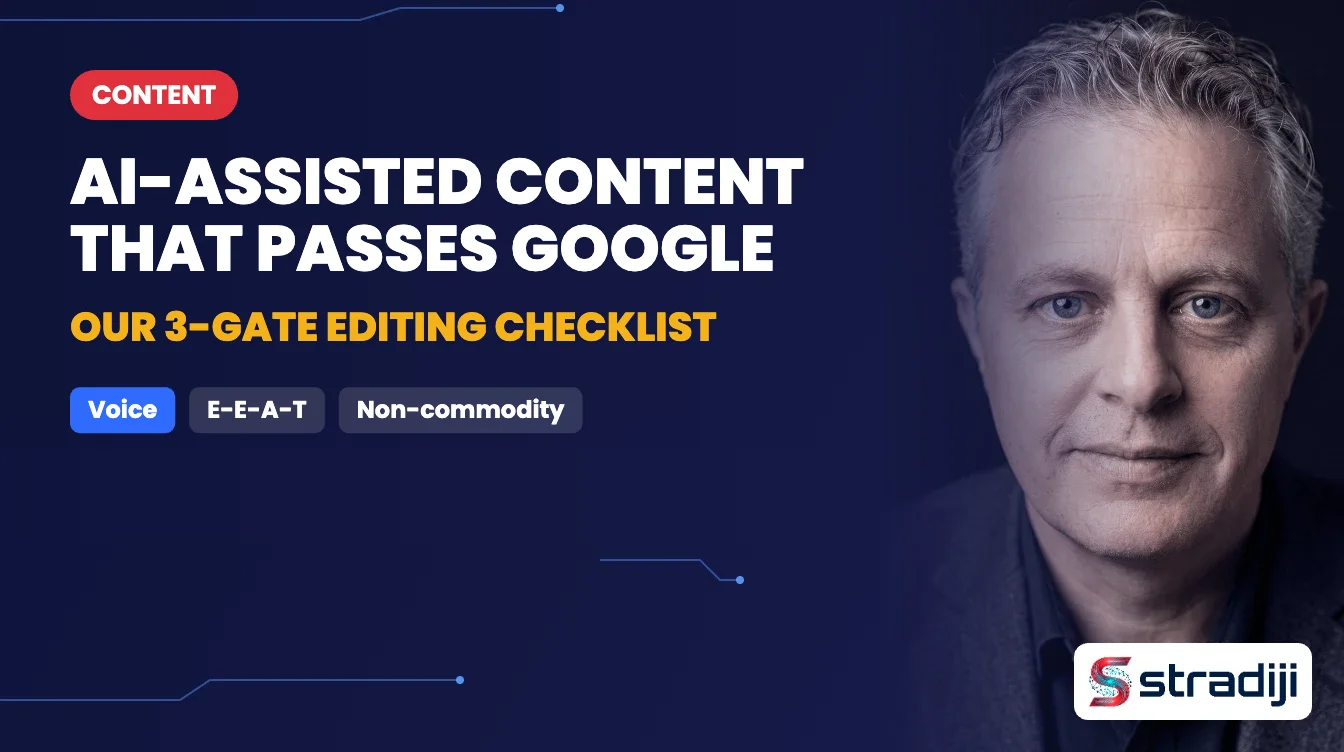
Forget “Humanizing” AI Content: How to Make AI-Assisted Content Pass Google’s Quality Bar
Last updated: November 1, 2026
Summary
AI-assisted content passes Google’s quality bar when a person verifies it, adds effort and evidence the model couldn’t produce, and puts a real name behind it. Google’s documentation got more explicit about this on Oct. 1, 2026: it now calls manual fact-checking of AI content “critical” and describes mass AI text without oversight as “little to no effort.” Trying to fool AI detectors misses that point entirely. Below: what changed at Google, the three-gate checklist we run on every draft and a before/after edit.
Why we rewrote this page: in Semrush, “humanize ai content” shows 590 U.S. searches a month, a keyword difficulty of 87 and a results page full of “humanizer” tools (Semrush, U.S. database, Nov. 1, 2026). That query asks the wrong question. So we rewrote the page around the right one.
Why “beating AI detectors” is the wrong goal
Google doesn’t rank pages by running them through an AI detector. Its stated position, going back to its February 2023 post on AI-generated content, is that it cares about the quality of the content, not how it was produced. We covered the evidence for that in Google doesn’t penalize AI content.
So a tool that rewrites your draft until a detector says “100% human” solves a problem Google doesn’t have, and can create one it does. The spam policies list, under scaled content abuse, content built “through automated transformations like synonymizing, translating, or other obfuscation techniques” where little value is provided. A humanizer that swaps words to hide where the text came from is, by design, an automated obfuscation layer. It changes the fingerprint, not the facts.
Our rule: we never ask “Will this pass a detector?” We ask “What does this page know that the model didn’t?” If the answer is nothing, no amount of rewording fixes it.
What Google changed in the fall of 2026
Three changes, one direction: oversight, effort and honest authorship.
1. Manual verification became “critical.” Google’s guidance on using generative AI content was updated on Oct. 1, 2026 (the Search Central documentation updates log lists it that day, with information from the Search Quality Rater Guidelines added). The page now says: “It is critical to manually factcheck and review all AI-generated content for accuracy and trustworthiness before publishing.” It extends that review to titles, meta descriptions, structured data and image alt text, because those can show up in search results too.
2. “Low effort” got a working definition. The same page borrows the rater guidelines’ description of low-effort main content: content “created with little to no effort, little to no originality, and little to no added value.” Google’s helpful content page now applies that directly to AI: “using generative AI to produce large amounts of text without manual oversight or curation represents little to no effort.”
3. Fake authors are now named as deception. The helpful content page’s “Who” section tells site owners to avoid deceptive authorship information, including “fabricating creator profiles (such as by using AI-generated headshots, made-up names, or false credentials).” It adds that any form of deception makes a page untrustworthy “to both users and our automated quality systems.”
Around the same time, the September 2026 spam update, the fourth of the year, started Sept. 24 and ran 13 days and 16 hours, per Google’s Search Status Dashboard. Google doesn’t say what each spam update targets, so we won’t claim it went after AI content. We do know scaled content abuse is a written policy, and it gets enforced.
The three gates: how we edit AI-assisted drafts at Stradiji
We use AI in our content work. We also publish nothing that hasn’t passed three gates. Voice comes first, because a draft that sounds wrong gets rewritten anyway. Trust is second. Originality is last, because it’s the hardest and it decides whether the page deserves to exist.
Gate 1: Brand voice. Does it sound like the person whose name is on it? We check against a written voice guide: short sentences, “we” language, a field observation in the opening, plain words over jargon and a banned-phrase list of the usual model tics. A draft that reads like a press release fails here.
Gate 2: E-E-A-T. Can a reader verify who wrote this and whether it’s true? Named author. A real author page with a real bio, not a generated headshot. Every number sourced and dated. Schema that matches the page. This gate maps almost line by line to the October changes above.
Gate 3: Non-commodity. Is there anything here the model couldn’t have written alone? We score six dimensions (proprietary evidence, firsthand experience, specificity, point of view, LLM moat and information gain) on a 100-point scale. The threshold is 70. The strategy behind the score lives in our non-commodity content post. This post is the application.
The most important rule in gate 3: if there’s no first-hand data, we don’t invent it. The draft gets a bracketed question for the human, like the “[MERT: …]” notes you can see in our working files. A model that fills the gap with a plausible client story is the “false credentials” problem Google just wrote down.
Yes, this post went through the same gates. The draft that reached Mert had four open questions in it, and the numbers you’ll read below are ours, with dates.
Here’s the checklist. Copy it into your editorial workflow.
THREE GATES: AI-ASSISTED DRAFT CHECKLIST (Stradiji)

GATE 1: BRAND VOICE
[ ] Opens with a real observation, not a definition or a cliche
[ ] Sounds like the named author (read one paragraph out loud)
[ ] Your banned-phrase list applied (model tics, filler openers)
[ ] Short sentences; jargon replaced or explained
[ ] One clear point of view the author would defend in public

GATE 2: E-E-A-T (Google: Who / How / Why)
[ ] Named author with a real author page (real photo, real bio)
[ ] Every number has a linked source AND a date
[ ] Every date, product name and quote checked by a person
[ ] Titles, meta description, alt text and schema reviewed too
[ ] AI use disclosed where readers would expect it (team decision)

GATE 3: NON-COMMODITY (score 0-100, threshold 70)
[ ] Proprietary evidence: our data, our screenshots, our tests
[ ] Firsthand experience: what we did, when, what happened
[ ] Specificity: names, numbers, dates, not "many businesses"
[ ] Point of view: a claim someone could disagree with
[ ] LLM moat: something a model can't produce from the web alone
[ ] Information gain: what this page adds to the top results
[ ] Missing first-hand data? DO NOT INVENT IT.
    Add [AUTHOR: question] and send the draft back.

Ship only if all three gates pass.
Want a second pair of eyes on your AI-assisted content?
We run this process for client content programs in the U.S., the U.K., Australia and Turkey. If your team publishes with AI help and isn’t sure where the bar is, we can review a sample with you.
What an editor actually does to an AI draft
Most “humanizing” advice is about style: vary sentence length, add a joke. Fine, but style is the easiest gate. Here’s what our editing pass really changes, in order of impact.
- Add first-hand data. A screenshot, a number from your analytics, a test you ran. This is the single biggest jump in score.
- Put a real name on it. Byline linked to an author page with a real bio and real profiles. No stock or generated portraits.
- Source every number, and date it. A “research says” with no link gets deleted, not softened.
- Fix the dates. Models get “current” wrong. We check every “latest” and “this year” by hand.
- Cut the filler. Intros that restate the title, conclusions that restate the intro, “it’s important to note.”
- Cut generic claims or prove them. “Speed matters for SEO” is true and useless. Either show what speed did on a specific site or drop the sentence.
- Review the metadata. Title, meta description, alt text and schema. Google’s Oct. 1 update names all four.
Before and after: one paragraph
Here’s a paragraph of the kind an AI tool hands us every week, on a topic we know well:
Before: AI chatbots are becoming an increasingly important source of website traffic. Many businesses are seeing growth in visitors from tools like ChatGPT and Gemini. It is crucial to track this traffic properly in Google Analytics so you can leverage these insights to optimize your marketing strategy and stay ahead of the competition.
Nothing in it is false or useful. Here’s our edit, with our own numbers:
After: On Nov. 1, 2026, we opened GA4 for stradiji.com and found Google’s default channel group already sorts some of this into an “AI Assistant” channel. In the last 28 days, chatgpt.com sent 16 sessions with 2 key events, and gemini.google.com sent 3. But 2 sessions from an “openai” source still landed in “Unassigned.” So we built a custom channel group with an AI channel at the top, matched on a source regex. One catch: the rule has to sit above Referral, or Referral swallows the traffic first.
What changed: a date, real counts, a gap, a fix and a warning. Nothing got “more human.” It got more specific, which is what gate 3 measures.
The same logic decides whether AI assistants cite you: generic pages are easy to summarize and easy to skip. More on that in Why is AI ignoring you?
Frequently asked questions
Does Google penalize AI-generated content?
Not for being AI-generated. Its spam policies target low-value, scaled content “no matter how it’s created.” AI-assisted content that a person has verified and improved is judged like any other page.
Should I use an AI humanizer tool to avoid detection?
We don’t recommend it. Google doesn’t rank by detector scores, and its spam policies list automated synonymizing as a scaled content abuse technique when it adds no value. Spend that time adding evidence.
What does “manual oversight” mean in practice?
A named person reads the full draft, checks every fact, number and date, reviews the metadata and adds what only your team knows. Google’s Oct. 1, 2026 update calls this review “critical.”
Do I need to disclose that I used AI?
Google’s helpful content page asks whether automation is “self-evident to visitors through disclosures or in other ways.” It’s not a mandatory label. Disclose where readers would reasonably expect to know.
Can I use AI-generated author photos or personas?
No. Google’s helpful content guidance now names AI-generated headshots, made-up names and false credentials as deceptive authorship. Use real people with real bios.
One thing to do this week
Take your three most recent AI-assisted posts. For each, write down the one fact, number or experience a model couldn’t have produced alone. Can’t name one? That post failed gate 3. Add one real, dated data point to it before you publish anything new.
Is your AI-assisted content good enough to be found and cited?
We review content against Google’s quality guidance and what AI search tools actually cite, then fix the gaps with your team. Bring a sample, and we’ll tell you honestly where it stands.

These May Also Interest You





The SEOs Diners Club · Weekly newsletter
Every Monday: what's actually moving in SEO and AI search
Mert Erkal breaks down one big shift each week, backed by real tests and data.
Free · 246 weekly issues since 2022 · Unsubscribe anytime
