
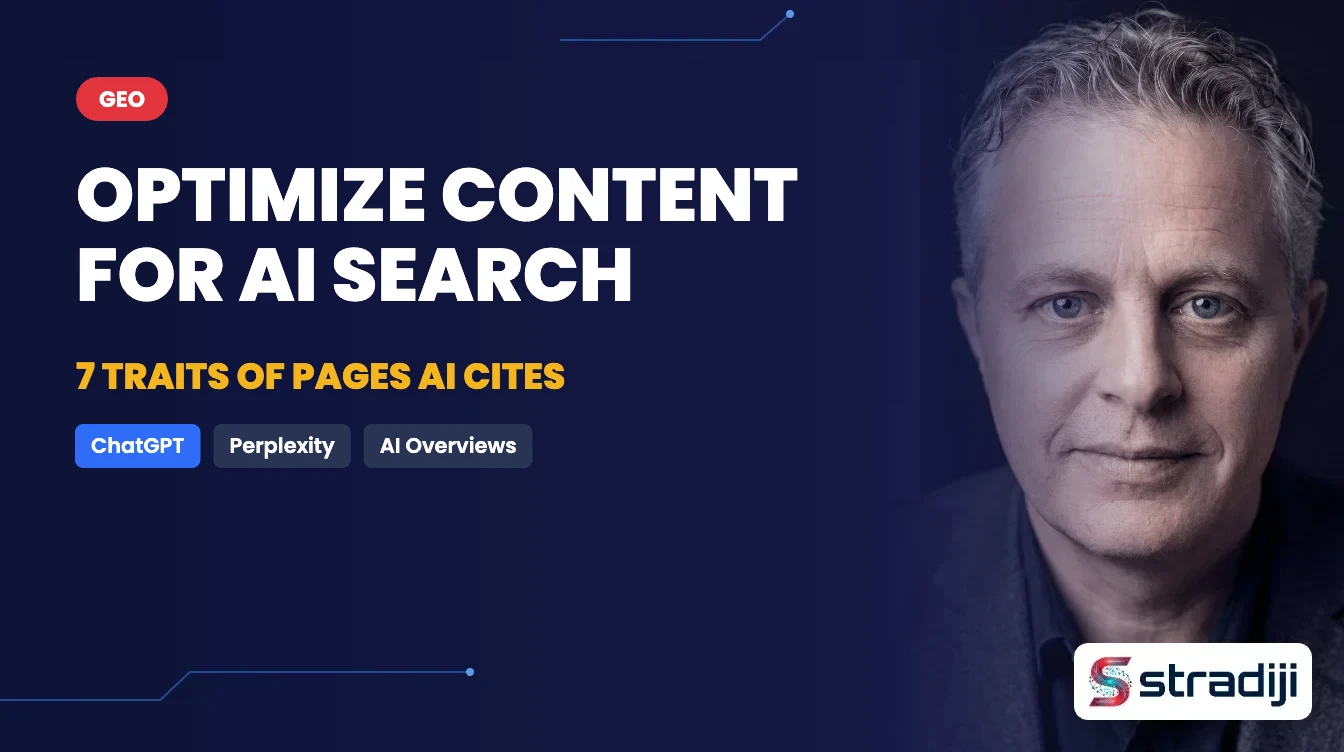
What do pages cited by ChatGPT, Perplexity and AI Overviews have in common? Seven traits we see in client work, with before-and-after examples.
1,534 views
How to Optimize Content for AI Search: 7 Traits of Pages AI Cites
Last updated: Nov. 6, 2026
Summary
Optimizing content for AI search means writing pages that ChatGPT, Perplexity, Gemini and Google’s AI Overviews can find, understand and cite as a source. It starts with SEO: a page that is not crawled, indexed or trusted will not be cited. On top of that, cited pages share three habits: answers that stand on their own, first-hand evidence and facts that match everywhere the brand appears.
This is not a separate discipline
Our view: Anyone saying “SEO is dead, GEO is here” is selling something. Many AI answers draw on pages that already rank and get crawled well. Good SEO is most of good GEO. The difference is how the page gets read: an AI system lifts the passage that answers the question, not the whole page.
7 traits of pages AI cites
1. The answer comes first
Answer the headline question in the first two or three sentences. Context and story come after.
2. Every passage stands alone
A paragraph that opens with “As mentioned above” loses its meaning when lifted into an AI answer. Name the subject in the first sentence under every H2.
| Before | After |
|---|---|
| “This approach offers many benefits and is widely used today.” | “A 301 redirect is a permanent redirect that passes an old URL’s links and rankings to a new URL.” |
3. Plain subject-verb-object sentences
“Google uses the mobile version for indexing” is easy for a machine to parse. Hedged, passive sentences are not.
4. Comparisons in tables
For “A vs. B” questions, AI answers often pull from tables. Put criteria in rows and options in columns.
5. First-hand evidence
Your own measurements, client cases and screenshots. Content anyone could write competes with everyone for the citation. We explain how we score this in our non-commodity content piece.
6. Visible date, author and sources
A last-updated date, a real author page and dated source links build trust with readers and machines.
7. Consistent facts everywhere
If your founding year differs between your site and LinkedIn, an AI system picks one or skips both. We found and fixed exactly this on our own site.
What to avoid
- Self-ranking listicles. Putting yourself first in “top 10 agencies” is easy for AI and readers to discount.
- Date-only refreshes. Changing the date without changing the content costs trust.
- Accidental bot blocks. Security plugins and CDN rules can block AI crawlers without telling you.
How ready is your site for AI search? Score technical access, content structure, entity consistency and trust signals in five minutes.
Frequently asked questions
What is AI search optimization?
It is the work of making content easy for AI-powered search systems to find, understand and cite. It is also called generative engine optimization (GEO).
Is GEO different from SEO?
SEO aims for rankings in search results. GEO aims for citations in AI answers. GEO builds on SEO.
How do I know if ChatGPT cites my content?
Ask a fixed set of questions regularly and log the results, or use a tracking tool. See how we measure AI search visibility.
Does FAQ schema still help?
Google shows FAQ rich results for very few sites now. A clear question-and-answer structure on the page still helps readers and AI systems.
The one thing to do this week
Open your top-traffic article and read only the first paragraph. Does it answer the headline? If not, rewrite that paragraph today. Then calculate your GEO score →
Sources
Google Search Central, AI features and your website: developers.google.com
Google Search Central, Creating helpful, reliable, people-first content: developers.google.com

These May Also Interest You





Make Stradiji a preferred source on Google
Google lets you pick the sources you want to see more of. Add Stradiji and our articles show up more often for you in search results and AI answers.
Add Stradiji on GoogleThe SEOs Diners Club
Every week, Mert Erkal breaks down what changed in SEO, GEO and AI search, backed by real tests and data. It's free.
Subscribe for freePopular Posts
The SEOs Diners Club · Weekly newsletter
Every Monday: what's actually moving in SEO and AI search
Mert Erkal breaks down one big shift each week, backed by real tests and data.
Free · 248 weekly issues since 2022 · Unsubscribe anytime
