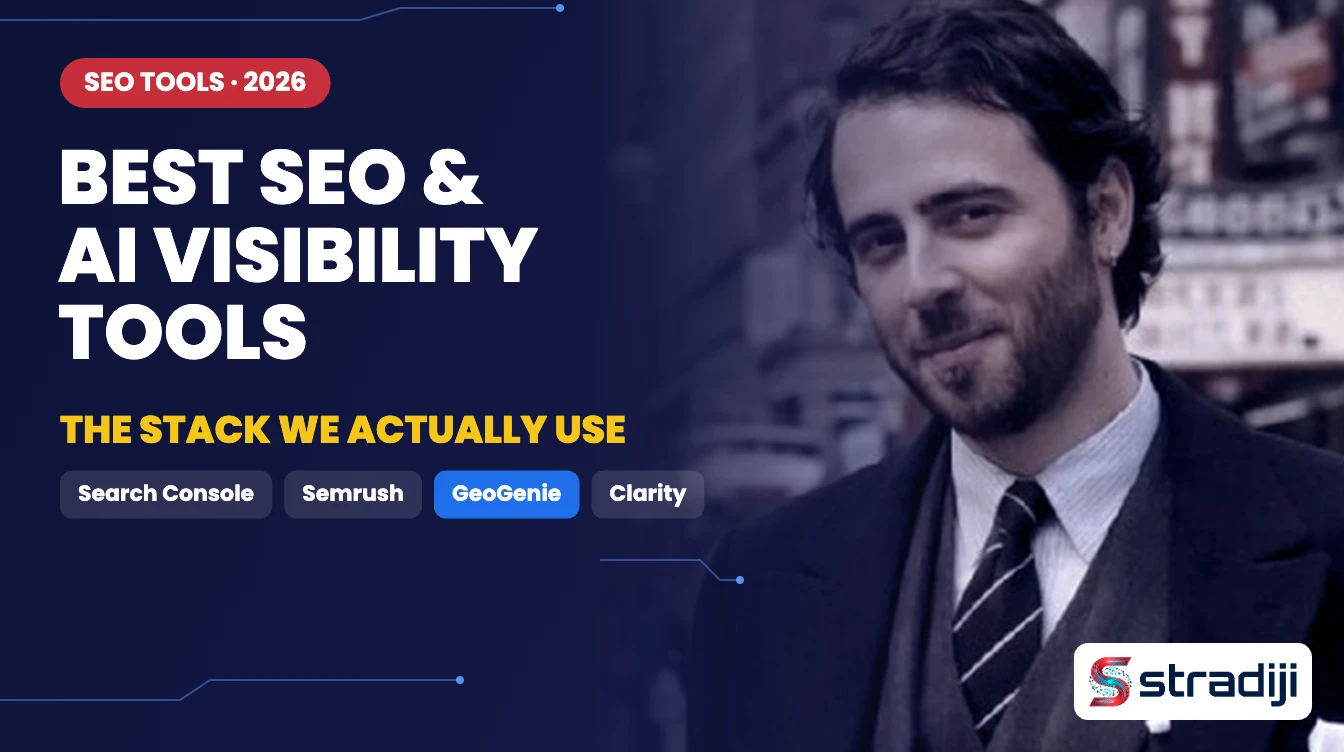
The SEO and AI visibility tools we use every week at Stradiji, what each one is good for, and what we dropped. Free and paid picks. See our full stack.
5,708 views
The Best SEO and AI Visibility Tools in 2026: The Stack We Actually Use
Some links in this post are affiliate links. If you buy through them, Stradiji earns a commission at no extra cost to you. A tool only makes this list if we used it on real work in the last 12 months.
Last updated: November 1, 2026
Summary
You can’t run SEO in 2026 with one tool, and you can’t measure AI visibility with your old SEO stack alone. Our weekly stack at Stradiji has six tools: Google Search Console (Google’s own data), Semrush (market and competitor data), Screaming Frog (technical crawling), GA4 and Microsoft Clarity (behavior and conversions), and GeoGenie (AI visibility tracking). On a zero budget, four free tools cover most of the ground: Search Console, Bing Webmaster Tools, Clarity and the free version of Screaming Frog.
One warning up front: don’t buy a paid SEO tool just for rank tracking. Since 2025, Google has deliberately made it harder for these tools to collect ranking data. For your own rankings, Search Console is still the most reliable source.
Why we rewrote this list
We first published this list in 2020. When we reopened it in October 2026, half of the tools on it were tools we no longer open. Searchmetrics, Moz, Majestic, Ryte, SEO Monitor and Black Widow are gone. Not because they’re bad. We simply didn’t use them on a single client project in the past year.
The new rule: if a tool is here, we used it this month or last month. If a popular tool isn’t in our stack, we say so.
The other change is bigger. The 2020 list didn’t mention AI once. Today a third of it is about whether ChatGPT, Gemini, Perplexity and Google’s AI Overviews mention your brand.
The stack at a glance
| Job | Free option | Paid option | How often we use it |
|---|---|---|---|
| See what Google sees, including your rankings | Google Search Console | Not needed | Daily |
| Keywords and competitors | Ubersuggest (limited) | Semrush | Every client |
| Technical crawl | Screaming Frog (up to 500 URLs) | Screaming Frog license | Weekly |
| Behavior and conversions | GA4 + Microsoft Clarity | Not needed | Every client |
| Does AI mention us? | Search Console AI report, Bing AI Performance, Clarity Citations | GeoGenie | Weekly |
| YouTube growth | YouTube Studio | vidIQ | Our own channel |
1. First-party data: Search Console and Bing Webmaster Tools
Google Search Console (free, daily). Every decision starts here. Since August 31, 2026, Search Console also has a generative AI performance report that shows, page by page, how often your content appears in AI Overviews and AI Mode. It shows impressions, not clicks or queries. Read it as a diagnostic, not a revenue number.
Bing Webmaster Tools (free, weekly). Most US teams we talk to haven’t set it up. That’s a mistake. Its AI Performance report shows which queries Microsoft Copilot cites you for, your citation share, and since October 13, 2026, a topic-level portfolio view. It’s the only free window we know into the “grounding queries” an AI model runs behind the scenes.
Here’s why we run both. In October 2026 we lined up the two reports for our own site: of the 31 URLs Bing cited, only 16 also showed up in Google’s AI report. Two engines, two different pictures of the same site.
2. Market and competitor data: Semrush or Ahrefs?
We had to make this call ourselves. We ran both side by side and chose Semrush. The reason is simple: keyword research, competitor analysis and site audits live in one place, and we can give each client a single shared view. Ahrefs is a strong tool, especially for backlinks. But paying twice for the same job makes no sense.
Semrush (paid, every client). We’ve used Semrush for more than five years. Every new client gets a Semrush project on day one, and we give the client read-only access to the parts we report on, so we’re always looking at the same numbers. We use it for keyword volume and difficulty, competitor gaps and Site Audit.
If your team works with Claude, this is the real differentiator. Semrush’s MCP (Model Context Protocol) connection lets Claude pull Semrush data directly. We ask for keyword volumes across the US and Turkey in one prompt and get a table back in seconds. No screenshots, no copy-paste. The search volumes in our planning docs this month came in that way. If your team already works with an AI assistant, put “Does it connect to our assistant?” at the top of your tool checklist.
New to Semrush? Start with The Beginner’s Guide to Semrush.
Ubersuggest (free tier, occasionally). The cheapest sensible entry point if budget is tight.
Why Google made rank tracking harder (read this before you buy)
Rank tracking in Semrush, Ahrefs and similar tools depends on collecting Google results automatically. Over the past two years, Google has made that harder in three steps:
1. SearchGuard (January 2025). Google launched a system it calls SearchGuard to stop bots from scraping search results. It uses JavaScript challenges that real browsers solve without noticing. Google disclosed the launch date in its own court filing (Search Engine Journal).
2. The num=100 parameter (September 2025). Tools used a URL parameter (\&num=100) to see the top 100 results in a single request. Google switched it off in September 2025. Seeing the top 100 now takes 10 separate requests, so the cost of tracking went up roughly tenfold. Some trackers cut their default tracking to the top 20. Search Console felt it too: in Tyler Gargula’s analysis of 319 properties, 87.7% of sites lost impressions in Search Console (Search Engine Land). Part of those impressions had never been human. They came from rank-tracking bots.
3. The SerpApi lawsuit (December 2025). On December 19, 2025, Google sued SerpApi, a company that collects Google results and resells them to other tools. In July 2026 the court dismissed Google’s copyright-based claims (PPC Land). That’s a win for the tools industry for now, but Google’s position is clear: it doesn’t want its results collected at scale.
Our recommendation: Don’t buy an SEO tool only for rank tracking. For your own site, Search Console is free and more reliable. Buy the paid tool for competitor research, keyword discovery, site audits and, if you work with Claude, MCP access to the data. Let rank tracking be a side feature of that package.
3. Technical crawling: Screaming Frog
Screaming Frog SEO Spider (free up to 500 URLs, paid license, weekly). It crawls your site like Googlebot and surfaces broken links, redirect chains, missing titles, duplicate content and canonical errors.
What changed for us: Screaming Frog runs on our office machine connected to Claude through MCP. We start a crawl and ask questions in plain English, like “Which pages canonicalize to a URL that returns a 301?” Work that used to take an afternoon of exports and filters now takes minutes.
One caution we learned the hard way: the model can misread a number in a table. Before anything goes to a client, we re-check every count against the exported CSV.
4. Behavior and conversions: GA4 and Microsoft Clarity
GA4 (free, every client). Where traffic comes from and whether it converts. Set it up through Google Tag Manager. Adding events later is much easier. If you need help with the setup, this is what our web analytics service does.
Microsoft Clarity (free, every client). Heatmaps and session recordings. GA4 tells you a form isn’t converting. Three Clarity recordings tell you why. Since May 2026, Clarity also has a Citations view that shows how often AI assistants cite your site.
5. AI visibility tools
This section didn’t exist in 2020. It’s now the part of the list that changes fastest.
| Tool | What it shows | Price | How we use it |
|---|---|---|---|
| Search Console generative AI report | Page-level impressions in Google’s AI features | Free | Weekly |
| Bing AI Performance | Copilot citations, grounding queries, citation share | Free | Weekly |
| Clarity Citations | Citations from AI assistants | Free | Every client |
| GeoGenie | Prompt-level visibility across ChatGPT, Gemini, Perplexity and more, with competitor comparison | Paid | US and Turkish clients |
How we use GeoGenie. The free trio tells you whether AI engines see you. GeoGenie answers the question your CMO actually asks: “On which buyer questions does a competitor get mentioned and we don’t?” We track a fixed set of prompts for each client every month and report the share of answers that mention them. If you want to see what that looks like for your brand, talk to us.
What no tool can tell you. AI answers are personalized. No tool can honestly say you “rank #1 in ChatGPT.” The right question is how often you’re mentioned and cited for a defined set of questions, measured the same way every month. We don’t guarantee rankings or citations, and you should be wary of anyone who does.
6. Content, video and off-site visibility
vidIQ (paid, our own channel). Topic, title and tag research for YouTube. We pick video topics for our channel with it.
Surfer (paid, no longer in our stack). We used it for content scoring for a while. Today Semrush and our own content review process cover that job, so Surfer became redundant for us. It can still be useful for larger content teams that want page-level guidance for writers.
WhitePress (paid). A marketplace for sponsored placements on publisher sites. AI models mention brands that other sites talk about, so off-site mentions matter. But buy placements only where people actually read, and only when you have something worth saying. We’ve used it on many client projects. Honestly, we find it a bit pricey. Lately we’ve taken a different route for online PR. First, we use GeoGenie to see which sites AI answers cite for our target prompts. Then we go to B2Press, which runs a global publisher network, and check whether those cited sites are in it. If a cited site is in the network, we place there. That way the budget goes to sites AI already reads and cites.
What we dropped, and why
| Tool | Why it’s gone |
|---|---|
| Searchmetrics, Ryte, SEO Monitor | Not opened on any project in 12 months |
| Moz, Majestic | We get authority and backlink data from Semrush |
| Surfer | Semrush and our own review process cover content scoring |
| Black Widow, Yandex Metrica | No longer relevant to our client base |
| Topic Explorer | We research topics with Semrush and Search Console queries |
Frequently asked questions
Are free SEO tools enough?
For a small site, usually for the first six months. Search Console, Bing Webmaster Tools, Clarity and Screaming Frog’s free version show you technical issues, queries and user behavior. You’ll need a paid tool for competitor research and keyword volume.
Should I pay for a rank tracker?
Not on its own. Google removed the parameter that let tools see the top 100 results in one request in September 2025, and it keeps making automated collection harder. For your own rankings, Search Console is more reliable. Pay for competitor and market data instead.
Semrush or Ahrefs?
Both are strong. We tested both and chose Semrush, because keywords, competitors and site audits live in one place, and its MCP connection works well with Claude. If your work is backlink-heavy, try Ahrefs. Don’t pay for both.
What’s the best tool to track AI visibility?
Start with the free first-party reports: Search Console’s generative AI report, Bing AI Performance and Clarity Citations. When you need prompt-level competitor comparison, add a tracking platform like GeoGenie.
The one thing to do this week
Set up Bing Webmaster Tools and open the AI Performance report. You’ll see, for the first time, which questions Copilot cites you for. Most teams are surprised by the list.
Is AI recommending you?
The free tools above show you what Google and Bing see. The GEO Score Card checks how ready your site is to show up in AI answers, across 38 checks and three doors: reach, recognize, believe. Free, five minutes.

These May Also Interest You


Make Stradiji a preferred source on Google
Google lets you pick the sources you want to see more of. Add Stradiji and our articles show up more often for you in search results and AI answers.
Add Stradiji on GoogleThe SEOs Diners Club
Every week, Mert Erkal breaks down what changed in SEO, GEO and AI search, backed by real tests and data. It's free.
Subscribe for freePopular Posts
The SEOs Diners Club · Weekly newsletter
Every Monday: what's actually moving in SEO and AI search
Mert Erkal breaks down one big shift each week, backed by real tests and data.
Free · 247 weekly issues since 2022 · Unsubscribe anytime
