AI Overviews show up on 98% of top US Black Friday shopping searches, every transactional one included. See the data and record your first screen today.
“AI Overviews Don’t Touch Money Queries.” We Checked 368 Black Friday Searches.

GEO Roadmap › Stage 7: Measure
Summary: Of the 149 highest-volume US searches around Black Friday deals, robot vacuums and headphones, 146 (98%) trigger a Google AI Overview. All 12 transactional queries do, and so do all 80 informational ones. In Türkiye, where we ran the same test on local campaign names, the rate is 85%. The money keywords aren’t safe. They never were.
There’s a comforting belief in our industry: “AI Overviews are an informational thing. They stay away from buying queries.” Semrush’s six-month study gave that belief some cover this summer. So during Black Friday week, we tested it on the searches that matter most, in the US and, because Stradiji is based in Istanbul, in Türkiye too. In the same week, Microsoft confirmed that ads now run inside Bing’s AI Overviews in every market except China.
In this post: the 368-query dataset, why Semrush’s “-5%” finding got misread, what a second market reveals about campaign names, how ads are moving into the summary, what the 25 Shopify stores we scanned tell us about who gets cited, and a 20-minute “first screen record” you can run before Cyber Monday ends.
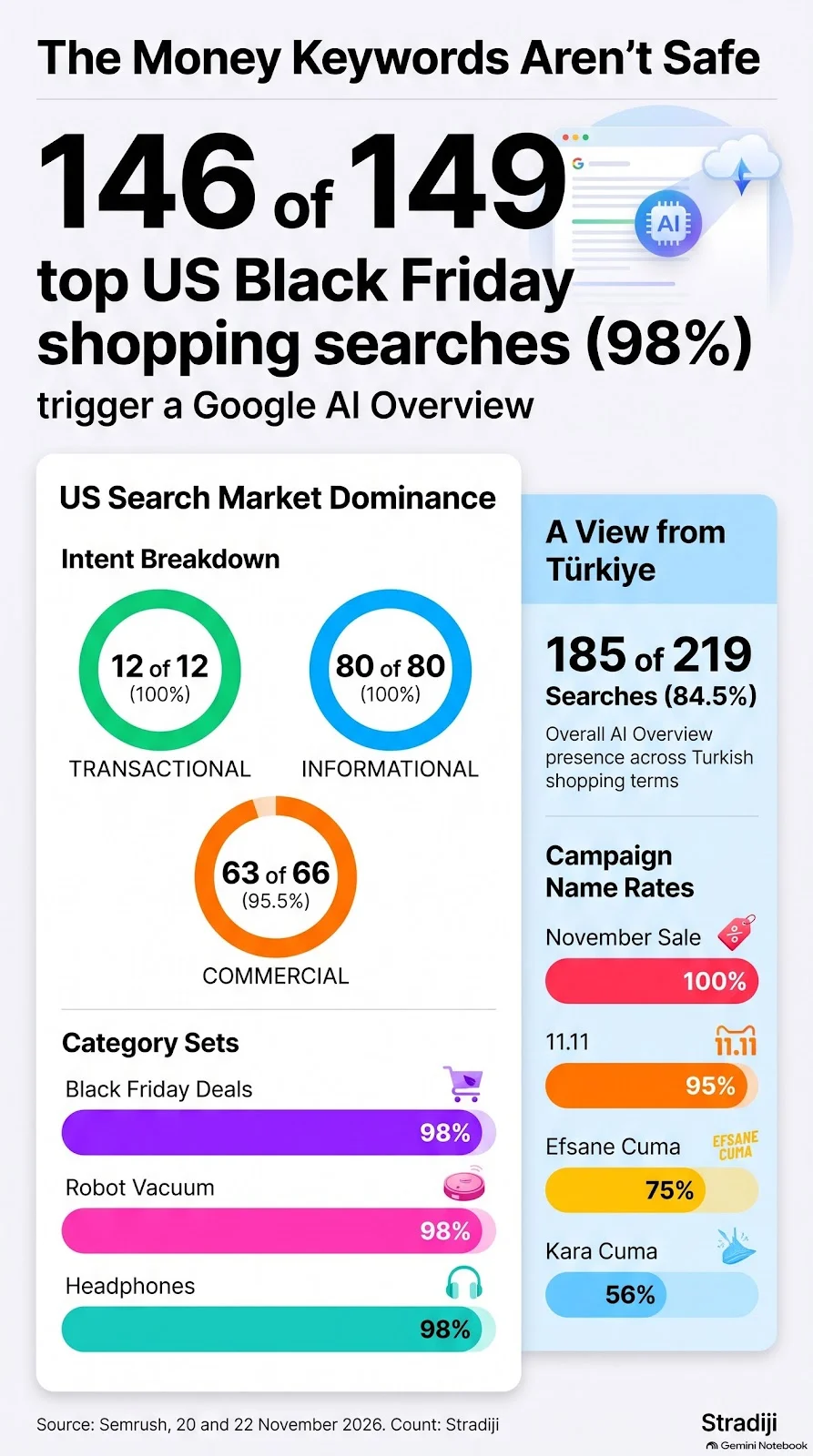
Infographic: AI Overviews on Black Friday shopping searches, US and Türkiye (Semrush, Nov. 20 and 22, 2026).
1. The data: 9 query sets, 2 countries, 368 searches
The question: During Black Friday season, how often does Google show an AI Overview on shopping searches?
The sample: For each seed keyword, the top 50 broad-match queries by search volume in Semrush. US: “black friday” for campaign searches, plus “robot vacuum” and “headphones,” two categories that get hammered with deals every November. Türkiye: the campaign names Turkish shoppers actually use (“kasım indirimleri,” the November sales; “11.11”; “Efsane Cuma,” the local Black Friday brand; and “Kara Cuma,” the literal translation), plus the same two categories in Turkish. We dropped rows with no SERP data, off-topic matches (a film is also called “Kara Cuma,” for example) and duplicates. That left 149 US and 219 Turkish queries.
The metric: Whether the AI Overview (SERP feature code 52) appears among the features Semrush records for the query.
| Segment | Result |
|---|---|
| Black Friday campaign searches (US) | 49 of 50 (98%) |
| Robot vacuum (US) | 49 of 50 (98%) |
| Headphones (US) | 48 of 49 (98%) |
| US total | 146 of 149 (98.0%); 98.7% weighted by search volume |
| US by intent | Transactional 12 of 12 · informational 80 of 80 · commercial 63 of 66 · navigational 19 of 20 |
| Türkiye total | 185 of 219 (84.5%) |
| Türkiye, transactional | 81 of 91 (89%) |
Data: Semrush phrase_fullsearch, US and Türkiye desktop databases, Nov. 20 and 22, 2026. Counting and classification: Stradiji. Public search data, not client data.
The three US queries without an AI Overview are almost comic: “black friday store,” “robot vacuum and” and “headphone by dre beats.” Everything a real shopper types this week gets one.
We turned the findings into a 9-slide deck: open it here (Google Slides, no sign-in needed).
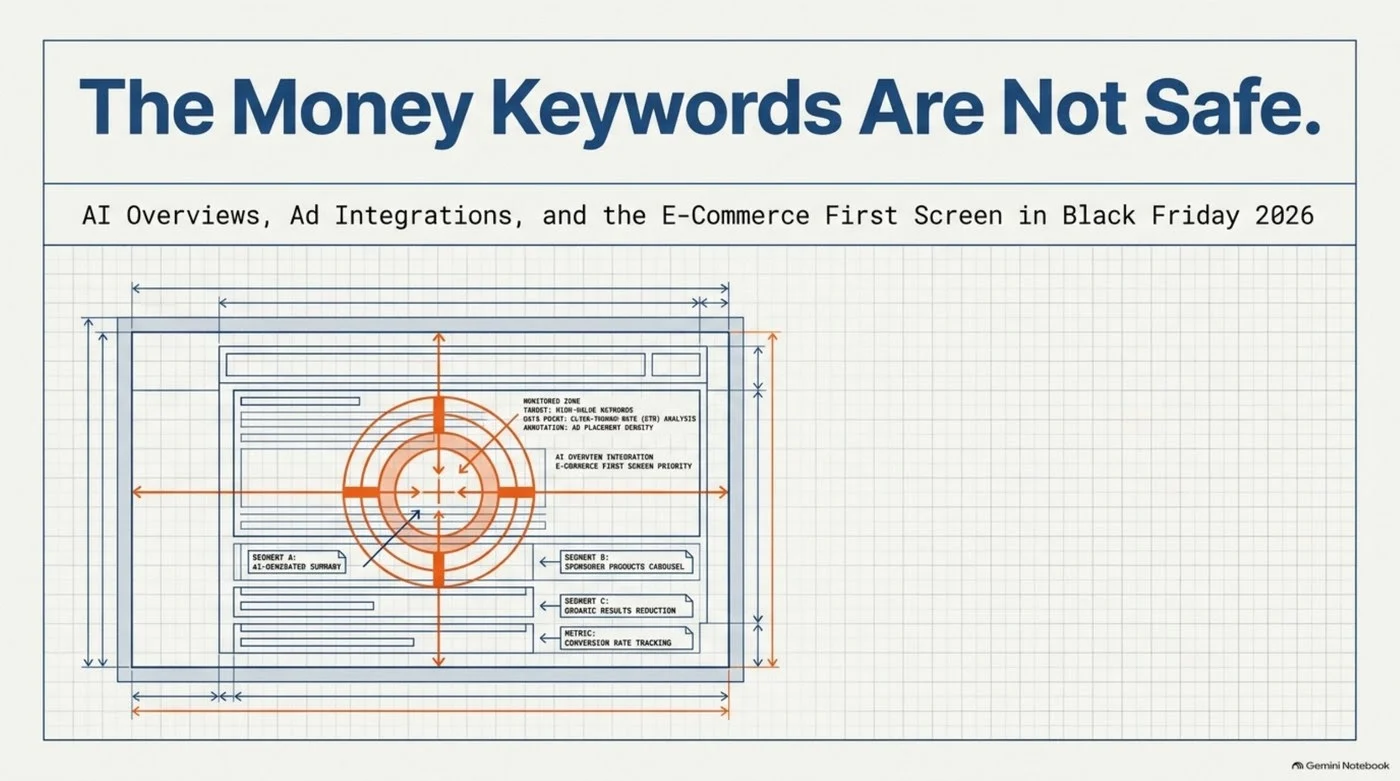
The first slide of the 9-slide deck. The full deck is at the Google Slides link above.
2. The correction everyone skipped: “-5%” doesn’t mean “rare”
This summer Semrush tracked more than 600,000 US keywords from November 2025 to April 2026. AI Overview appearances on commercial-intent queries grew 71%, while appearances on transactional-intent queries fell 5% (Semrush’s commercial search study, July 2026). Plenty of us read the second number as good news: “Google is pulling AI Overviews back from buying queries.”
Our Black Friday data doesn’t support that reading. All 12 transactional US queries in the sample trigger an AI Overview. So do “best robot vacuum,” “best noise cancelling headphones” and “walmart black friday deals.”
To be fair to Semrush: their study measures a change over six months across a huge sample. Ours measures presence at one moment, in the highest-volume shopping queries of the busiest week of the year. The two don’t contradict each other. But “-5%” should never have been read as “AI Overviews are rare on money queries.” On the head terms that drive Black Friday revenue, they’re the default.
The same study found that Google Ads and AI Overviews now share a results page about twice as often as a year earlier. That’s the other half of the picture.
3. The ad moves into the summary
Two things happened in the last ten days that make these numbers urgent:
- Bing, all markets except China: Microsoft confirmed that ads now show inside AI Overviews on Bing. They run from existing campaigns, including Performance Max and AI Max (Search Engine Roundtable, Nov. 19, 2026). If you run Microsoft Ads, your Black Friday budget may already be showing up inside an AI answer without any change on your side.
- Google AI Mode: Glenn Gabe caught sponsored product cards labeled as options “from local retailers” under an AI Mode answer for golf shoes. On Alphabet’s third-quarter call, management pointed to lower monetization in AI Mode and said ads are scaling to more users and queries (PPC Land, Nov. 12, 2026).
As the summary takes over the organic first screen, the ad follows it in. This week, SEO and paid search are looking at the same box.
4. A view from Türkiye: The campaign name decides
Here’s where a second market earns its place. In Türkiye, the overall rate is about 13 points below the US. The interesting part is where the gap sits:
- “Kasım indirimleri” (November sales): 49 of 49 (100%). Most of these are date questions with a retailer’s name, such as “when does the Trendyol November sale start?” Google now answers the date itself, at the top of the page, before the retailer’s campaign page gets a click.
- “11.11”: 19 of 20 (95%).
- “Efsane Cuma” (Türkiye’s own Black Friday brand): 21 of 28 (75%).
- “Kara Cuma” (literally “Black Friday”): 14 of 25 (56%). The bare term shares its name with a film, and 9 of the 11 queries without an AI Overview ask about past years (“kara cuma 2021 date”).
That last point is the transferable lesson. In Türkiye, past-year queries get an AI Overview 74% of the time; queries without a year, 87%. In the US, every past-year query in the sample still gets one. Our read, and it’s a hypothesis: when a language has thin, inconsistent content about past campaigns, the AI has nothing clean to summarize, so Google falls back to blue links. The US web has covered past Black Fridays in depth for years. The Turkish web hasn’t.
For US marketers selling into smaller or non-English markets, that’s an opening: the first site to publish clear, dated, consistent campaign pages in the local language may be the page the AI learns from.
5. Who gets cited? What 25 US Shopify stores told us
An AI Overview showing up is one thing. Your page being its source is another. In late October we scanned 25 Shopify stores selling to US buyers, reading only public files and one product page each (our Shopify SEO 2026 checklist). Shopify’s defaults already cover most of the AI plumbing: 22 of 25 stores had a UCP profile and 19 had llms.txt. The gap is product data. Every store had product schema, but only 5 of the 23 readable product pages had a GTIN, and 15 had no review rating at all.
The same scan made the point this week’s data reinforces: the heavy lifting for AI visibility is still done by classic Google search foundations. The pages AI Overviews cite are, overwhelmingly, pages that already rank. We saw exactly that in health.
Before the season, we also published an AI shopping agent readiness checklist built around four gates: reach, recognition, trust and purchase. One number from it, via Microsoft Clarity: 25.2% of AI agent sessions reached checkout, against 14.7% of human sessions.
6. What we couldn’t prove
- Semrush records the SERP features from each query’s latest crawl, so the 368 queries may not have been crawled on the same day.
- The sample is the top 50 by volume per seed, so it doesn’t represent the long tail.
- Intent labels are Semrush’s automatic labels.
- We measured whether an AI Overview appears, not whether your brand is cited in it.
- This is Semrush’s SERP data, not a live Google test.
7. One thing to do this week: a 20-minute “first screen record” before Cyber Monday
Black Friday and Cyber Monday end this week. Once they’re gone, you can’t see this first screen again. Record it now so that next November you have a baseline:
- List your 10 highest-revenue category queries and your 10 campaign date queries (“[your brand] black friday,” “[your brand] cyber monday hours”).
- In Semrush, open phrase_fullsearch or Keyword Magic Tool, turn on the SERP features column and flag queries with an AI Overview.
- Open Google logged out for the flagged queries. Screenshot the AI’s answer and its cited sources, with the date. Are you there, or is it a marketplace or a coupon site?
- If you’re not cited, make one fix this week: put the start date, end date, scope and return policy in three short sentences at the top of your campaign page. Add GTIN and review ratings to your product schema.
Want us to run the record for your category? Get your free AI Visibility Snapshot.
Closing
On Friday morning, someone will search “best robot vacuum black friday,” and the first sentence they read won’t be yours. It will be Google’s, with an ad close by. In the US, that box is already on almost every shopping search. In Türkiye, it still skips some local campaign names and past-year questions. Same algorithm, different web.
If you want to measure how your store shows up in AI answers and become the source, take a look at our GEO consulting. To see research like this first in Google, you can add Stradiji as a preferred source.
This post is adapted from the lead story of The SEOs Diners Club #248, published Nov. 23, 2026.

These May Also Interest You




Make Stradiji a preferred source on Google
Google lets you pick the sources you want to see more of. Add Stradiji and our articles show up more often for you in search results and AI answers.
Add Stradiji on GoogleThe SEOs Diners Club
Every week, Mert Erkal breaks down what changed in SEO, GEO and AI search, backed by real tests and data. It's free.
Subscribe for freePopular Posts
The SEOs Diners Club · Weekly newsletter
Every Monday: what's actually moving in SEO and AI search
Mert Erkal breaks down one big shift each week, backed by real tests and data.
Free · 248 weekly issues since 2022 · Unsubscribe anytime
