
In the US, 70% of AI Overview health sources are academic centers and agencies. In Turkish, 95% are private hospitals. What US healthcare marketers should do.
Google’s AI Sends You to Mayo Clinic. In Turkish, It Sends You to a Hospital Chain.
Part of the GEO Roadmap › Stage 5: Do they trust what they find?
Summary: In the US, Google’s AI Overviews pull 70% of their sources for 12 common health questions from non-profit academic medical centers and public agencies: Mayo Clinic, Cleveland Clinic, CDC, NIH, MedlinePlus. Ask the same questions in Spanish from the US and public sources still lead, with zero commercial providers. Ask them in Turkish and 57 of 60 sources (95%) are private hospital chains and doctors’ practice sites. Then comes the last sentence. In English, the AI sends you on to Mayo Clinic, the CDC or the American Diabetes Association. In Turkish, 5 out of 5 answers send you, by name, to two private hospital groups. Google isn’t playing favorites. It summarizes what ranks. What that shows US marketers is how much the US public health web quietly does for Google, and what AI search looks like without it.
Google keeps saying its AI Overviews for health questions “continue to meet a high bar for clinical factuality” (Search Engine Journal, March 2025). Most of us in SEO believe a version of that too: for health, Google only trusts the official sources. In the US, that’s mostly true. I checked. But I run Stradiji from Istanbul, so I asked a different question: does that bar travel?
I put the same 12 health questions to Google in English, Spanish and Turkish, counted every source its AI cited, then opened Google live and read every answer to the last line. The last line turned out to be the story.
In this post: who gets cited for 12 health questions in three languages, where the AI sends the reader next, what the cited pages have in common, what it means if you market healthcare in the US, and a 20-minute check you can run this week.
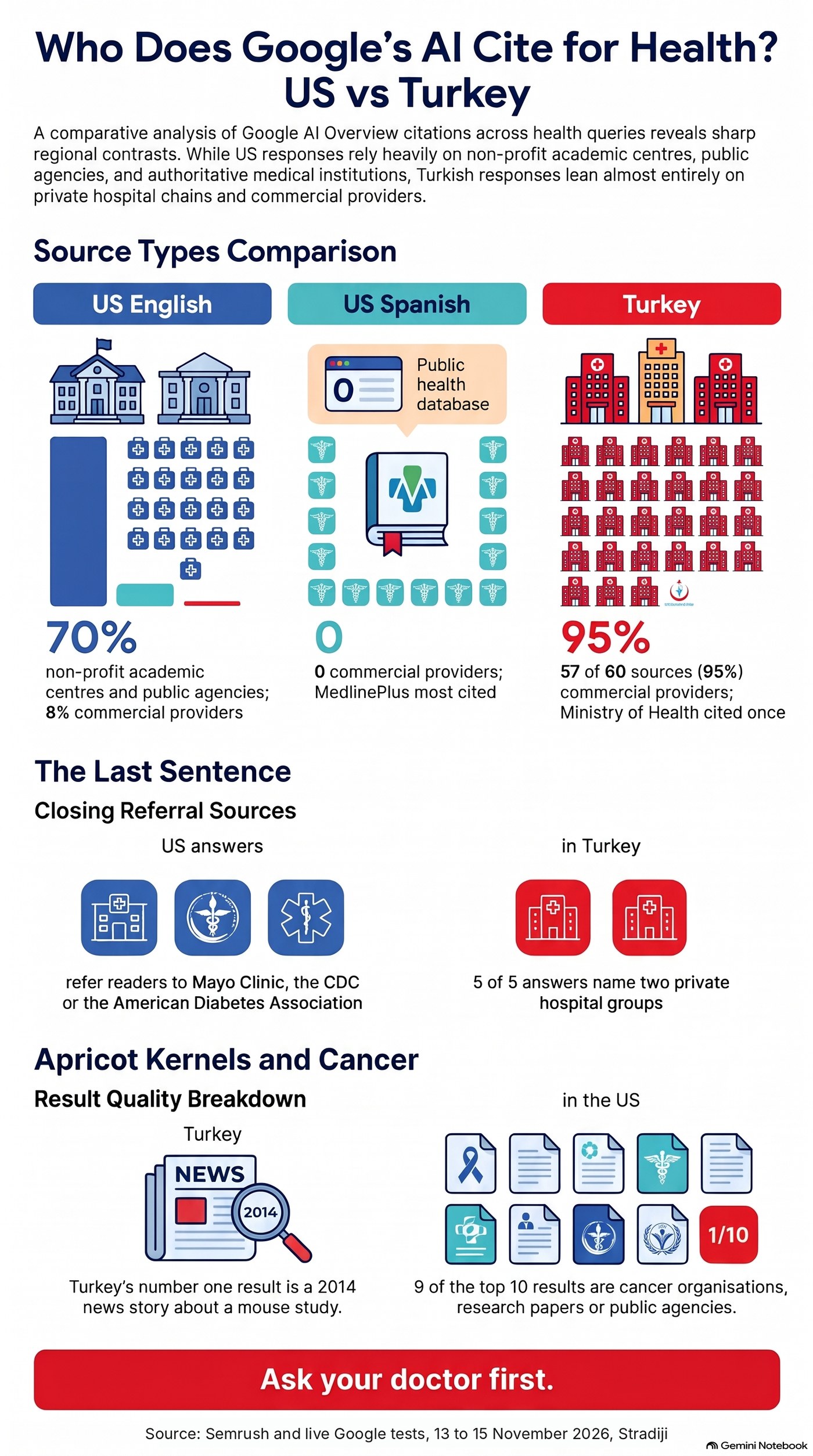
Infographic made with NotebookLM from this research.
1. My data: 12 questions, 3 languages, 150 sources
The question: When Google’s AI answers a health question, whose pages does it cite?
The sample: 12 everyday health questions in English and Turkish: headaches, vitamin D deficiency, sleep apnea, blood pressure, diabetes, migraine, iron deficiency, cholesterol, anxiety, acid reflux, thyroid and herniated disc. All 24 queries trigger an AI Overview. As a US control, I added 6 of the same questions in Spanish from Semrush’s US database.
The method: From Semrush (Nov. 13 and 15, 2026, desktop) I took the domains each AI Overview cites, five per query, and sorted every domain into one of four buckets.
| Source type | US English | US Spanish | Türkiye |
|---|---|---|---|
| Commercial providers (private hospitals, health groups, practices) | 5 of 60 (8%) | 0 of 30 | 57 of 60 (95%) |
| Non-profit academic medical centers | 33 (55%) | 7 (23%) | 0 |
| Public agencies and medical associations | 9 (15%) | 10 (33%) | 2 (3%) |
| Media, platforms, insurers | 13 (22%) | 13 (43%) | 1 (2%) |
| Most cited domain | Cleveland Clinic and Mayo Clinic, 7 of 12 queries each | MedlinePlus | One private hospital group, in 11 of 12 queries |
Source: Semrush, US and Türkiye databases, Nov. 13-15, 2026. Classification: Stradiji. Public search data, not client data.
A fair caveat first: Mayo Clinic is a hospital too, with “Request an appointment” buttons all over its pages. The difference isn’t “hospital or not.” It’s that US citations go to non-profit institutions sitting next to federal agencies. In Türkiye, the Ministry of Health appears once in 60 citations.
2. The live test: The AI doesn’t just cite. It refers.
On Nov. 15, I asked 9 questions live, logged out, and saved every answer in full. The surprise was the closing line:
| Query | Where the AI’s last sentence sends the reader |
|---|---|
| anxiety symptoms (US) | “…which you can review further through the Mayo Clinic Anxiety Guide.” |
| diabetes symptoms (US) | “…available through the American Diabetes Association.” |
| how to lower blood pressure (US) | “…the Mayo Clinic Guide to High Blood Pressure or … the CDC High Blood Pressure Resource Center.” |
| what is a migraine (US) | “…the American Migraine Foundation and the Mayo Clinic outline clear strategies…” |
| anxiety symptoms (Turkish) | “For a detailed mental health assessment and a personalized approach, you can get professional support from institutions such as [hospital group A] or [hospital group B].” (my translation) |
| migraine, diabetes, blood pressure, fever (Turkish) | Each ends with “you can review [hospital group A] or [hospital group B] health guides.” |
Source: Live Google search, logged out, Nov. 15, 2026.
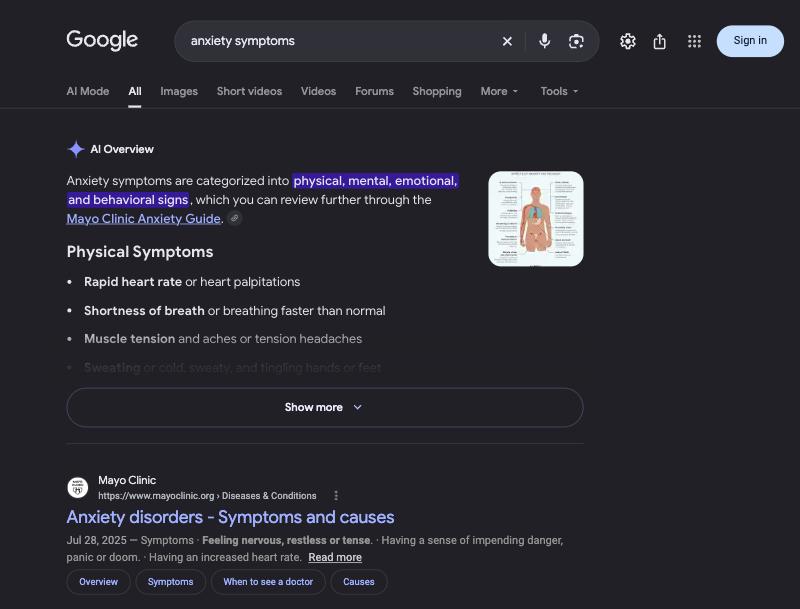
US: the AI sends you to the Mayo Clinic guide. Nov. 15, 2026.
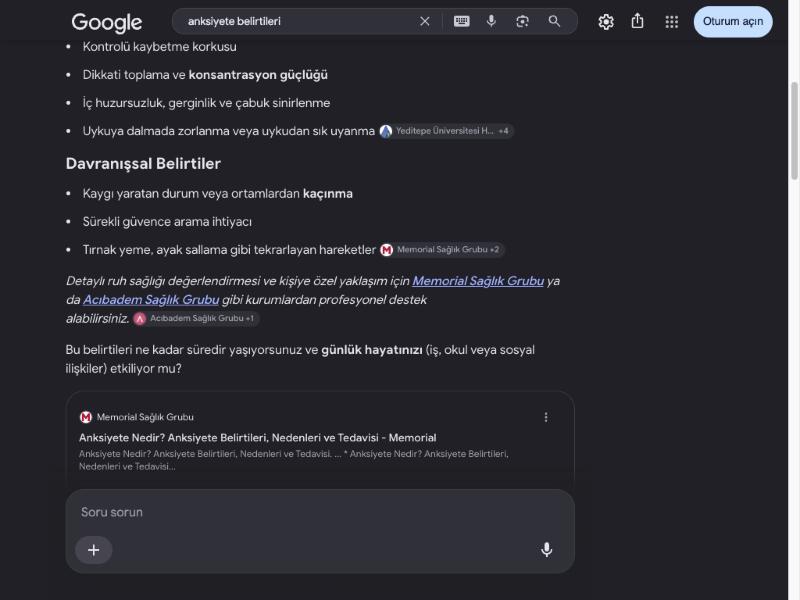
Türkiye: the same question ends with two private hospital groups. Nov. 15, 2026.
Two things matter here. Sending the reader on is a global Google habit; the difference is who it sends them to. And the anxiety answer stands apart: in Turkish, the AI isn’t recommending a guide. It’s recommending where to get mental health care. The US answer to the same question points to a reading resource.
3. How sure are we?
I asked myself whether I was trusting a tool’s snapshot. Three layers:
- Semrush: 30 queries, 150 cited sources. Anyone can rerun them.
- Live Google: 9 queries, full text and screenshots. The source lists don’t match Semrush one-to-one, but the bucket split does.
- The classic top 10: In 4 Turkish queries, 34 of the 36 organic results (excluding YouTube and Instagram) are private hospitals or doctors’ sites. 15 of the 19 pages the AI cited (79%) already rank in that top 10.
So the AI doesn’t pick private hospitals. Turkish health search already looks like that; the AI summarizes it and then names names.
Limits: 12 questions, one vertical, one day of live tests from one location. My US tests ran from Istanbul with Google’s US setting. The Spanish sample is only 6 queries. I’m not claiming Google favors anyone.
I turned the findings into an 11-slide deck: open the slides here (Google Slides, view-only, no sign-in needed).
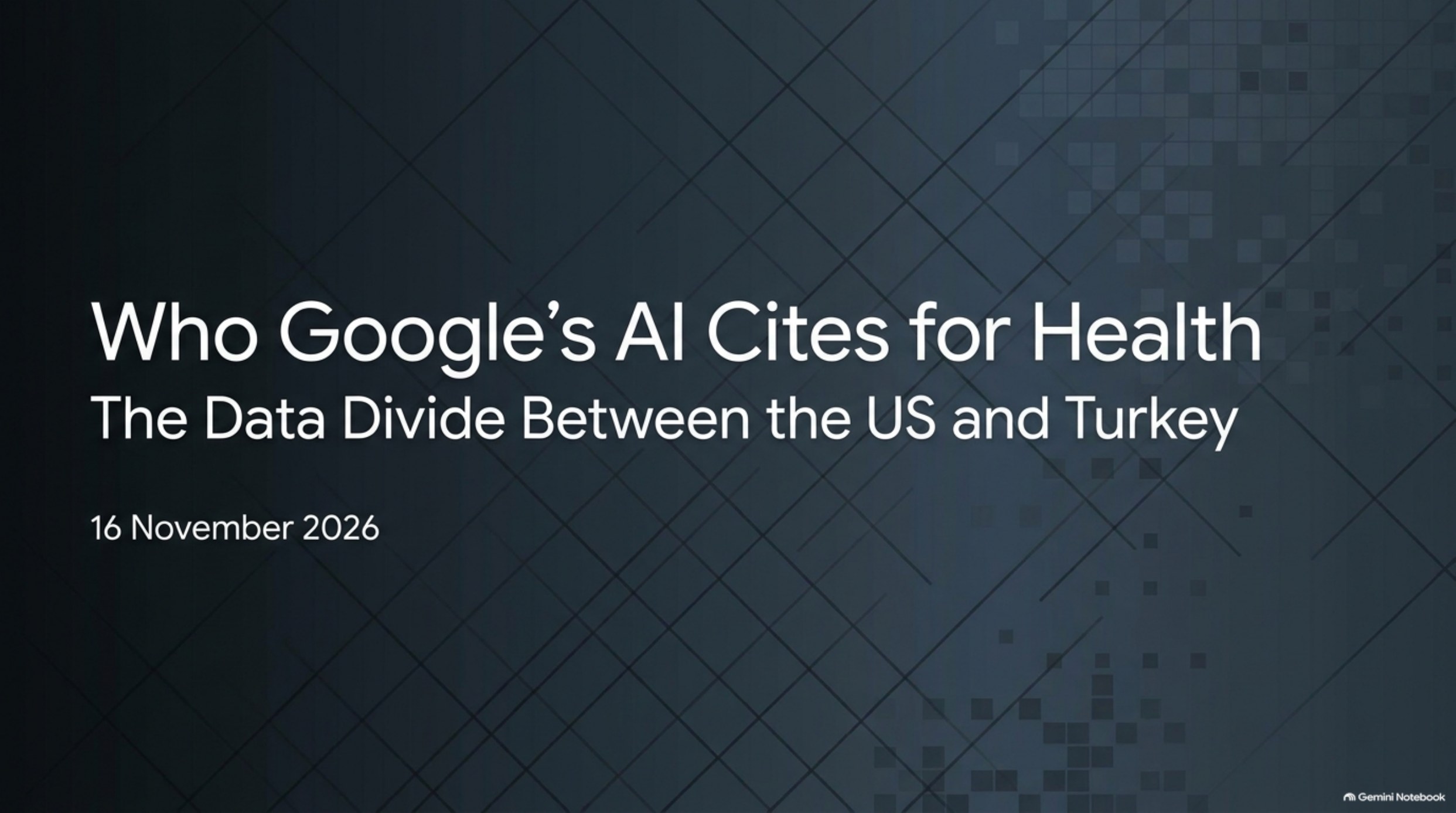
Slide 1 of 11. Full deck on Google Slides (link above).
Is it only Türkiye? No. SE Ranking looked at 50,807 German health queries and found YouTube was the most-cited domain, with government and academic sources at roughly 1% (SE Ranking, January 2026). When trusted public health content is thin in a language, someone fills the gap. In Germany it’s YouTube. In Türkiye it’s private hospitals.
4. What this means if you market healthcare in the US
Your competitor in AI Overviews isn’t the clinic down the road. It’s Mayo Clinic, Cleveland Clinic and MedlinePlus, and the AI’s closing line names them. A US practice or health system won’t outrank Mayo on “what is a migraine.” Pick narrower questions where you have something Mayo doesn’t: local, procedural or specialist detail.
Spanish is the open door. In US Spanish queries, 43% of citations went to media and platforms: YouTube alone took 9 of 30 slots, and twice the AI cited Google Translate itself. No commercial provider made the list. If you serve Spanish-speaking patients and publish solid Spanish pages, that slot is far less defended than the English one.
What the cited pages share. I opened seven cited and uncited pages with the same script on Nov. 15. Five patterns:
- Organic rank is the strongest signal. The most-cited Turkish page ranks No. 1 organically in all four queries I checked.
- A predictable template. Up to 19 question-style subheads per page, or Mayo’s fixed “Symptoms, Causes, When to see a doctor” order.
- Medical schema. Mostly MedicalWebPage; the one uncited page had none.
- Freshness. Two of the pages were updated a day or two before my test.
- Weak bylines. Most say “Editorial Board” or “Mayo Clinic Staff,” and none names a physician. A named, credentialed reviewer is an open lane, in Türkiye and the US alike.
New to the schema side? Our updated guide is here: What Is Schema Markup? The 2026 Guide With a Live Tester.
5. A rule hospitals must follow, and Google doesn’t
Here’s the part US readers find hardest to believe. Türkiye bans health advertising outright. A regulation published on Nov. 12, 2025 (Official Gazette No. 33075) says health information “cannot direct the patient, directly or indirectly, to a health professional or health institution,” and that search result pages must not break those principles either (my translation).
So a Turkish hospital can’t tell you “come to us.” Google’s AI, which the regulation doesn’t cover, says it for them, by name, at the top of the page. A caveat: I’m not a lawyer and I’m not blaming the hospitals; they publish good, legal information. But the gap is real. Türkiye’s competition authority opened an investigation into Google’s AI features this month, focused on news publishers, not health.
For US readers, the question travels: when an AI answer names one provider at the end of a health question, is that information, a recommendation, or an ad nobody paid for?
6. Funny, but true: A 12-year-old news story at No. 1
AI health misfires have been logged for a long time. You know the classics: the “eat at least one small rock a day” answer from May 2024, and the January 2026 Guardian investigation that led Google to pull some health Overviews (TechCrunch).
In Turkish I couldn’t catch a dangerous answer in 8 tries. The funny part came from elsewhere. I asked “does apricot kernel cure cancer?” The AI got it right: “No,” with a cyanide warning. The first blue link right under it is a national news agency story from July 30, 2014: “Bitter apricot kernel kills cancer cells.” It reported a study in mice. Semrush shows the same story at No. 1 for “apricot kernel cancer” in Türkiye.
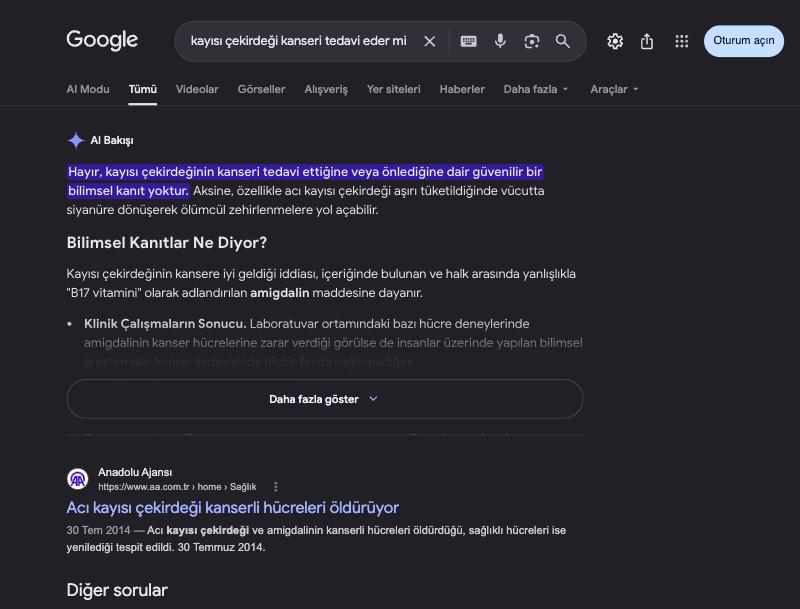
Türkiye: a 2014 news-agency story about a mouse study ranks first.
The science says otherwise: a Cochrane review found no reliable evidence that amygdalin cures cancer, and the European Food Safety Authority puts the safe one-off limit at three small raw kernels for an adult and half a kernel for a toddler.
Same question in the US: “do apricot kernels cure cancer.” The AI says “No,” and the first result is Cancer Council Australia’s myth-buster.
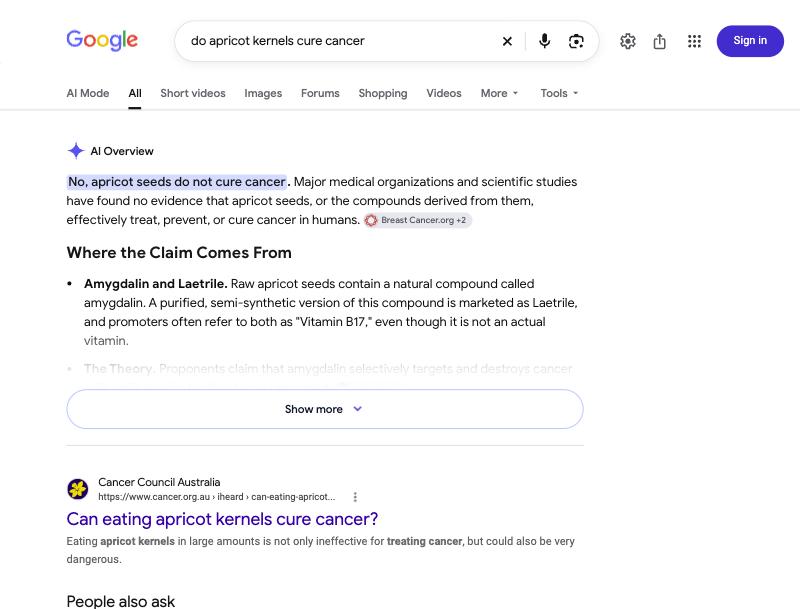
US: cancer organizations fill the top results.
| Top 10 for “apricot kernels cancer” | US | Türkiye |
|---|---|---|
| Cancer organizations, research papers or public agencies | 9 of 10 | 0 |
| “Benefits of apricot kernels” pages | 0 | 3 |
| Social posts (Facebook, Instagram, YouTube) | 0 | 3 |
| Nut shops | 0 | 2 |
Source: Semrush and live Google search, Nov. 15, 2026.
Google asks every health site for E-E-A-T and for content that matches expert consensus (Google Search Central). Then it puts a 12-year-old mouse study, reported by a news agency, at the top of a cancer question. In English, E-E-A-T looks like it checks the claim. In Turkish, it looks like it checks the domain.
The message is simple: neither an AI answer nor a search result replaces your doctor. Google prints the same line under every health Overview.
7. One thing to do this week: A 20-minute “who’s in the seat” check
- Write down the 5 questions your patients ask most.
- In Semrush, run
phrase_organicwithpositions_type: all. Rows with position type 52 are the AI Overview sources. - Run them in English and, if you serve Spanish speakers, in Spanish.
- Label each source: academic center, public agency, platform, competitor, you. Then read the AI’s last sentence. Who does it send people to?
- Compare your page with the patterns above: top 10? Question-style subheads? MedicalWebPage? A visible update date and a named physician?
Want us to run it for you? Tell us your specialty and we’ll pull the AI sources and referral lines for your 5 top questions, free: Get your free AI Visibility Snapshot.
Closing
In the US, Google’s AI answers a health question with Mayo Clinic’s words and sends you to the CDC. In Türkiye, it answers with a hospital chain’s words and sends you to that chain. Same algorithm, different web. It makes me wonder how many US marketers realize that the bar they compete against was built by MedlinePlus, not by Google.
Is that citation slot worth the fight? Our data says yes: visitors from AI convert 1.6x better.
Your turn: if you work in US healthcare, run the 20-minute check on your top 5 questions and tell us who sits in the seat. If you’d rather have us map it with you, here’s how our GEO consulting works. And to see research like this first in Google, you can add Stradiji as a preferred source.

These May Also Interest You
Make Stradiji a preferred source on Google
Google lets you pick the sources you want to see more of. Add Stradiji and our articles show up more often for you in search results and AI answers.
Add Stradiji on GoogleThe SEOs Diners Club
Every week, Mert Erkal breaks down what changed in SEO, GEO and AI search, backed by real tests and data. It's free.
Subscribe for freePopular Posts
The SEOs Diners Club · Weekly newsletter
Every Monday: what's actually moving in SEO and AI search
Mert Erkal breaks down one big shift each week, backed by real tests and data.
Free · 247 weekly issues since 2022 · Unsubscribe anytime
