
Fine-tuning is training an existing AI model a little further on your own examples so it adopts a specific style, format or behavior. It changes the model’s weights, the numbers it learned in training. It’s the right tool for teaching a model how to answer. It’s usually the wrong tool for teaching it facts that change.
How fine-tuning works
- Start with a pretrained model. It already knows language from training on huge amounts of text.
- Prepare examples. Usually hundreds or thousands of input and ideal-output pairs in your format and tone.
- Train briefly. The model adjusts its weights to match your examples. Methods like LoRA, introduced by Microsoft researchers in 2021, update only a small set of extra weights, which makes this much cheaper.
- Evaluate. Test the tuned model against cases it hasn’t seen, because a model can learn the examples and still get new ones wrong.
Fine-tuning vs RAG vs prompting
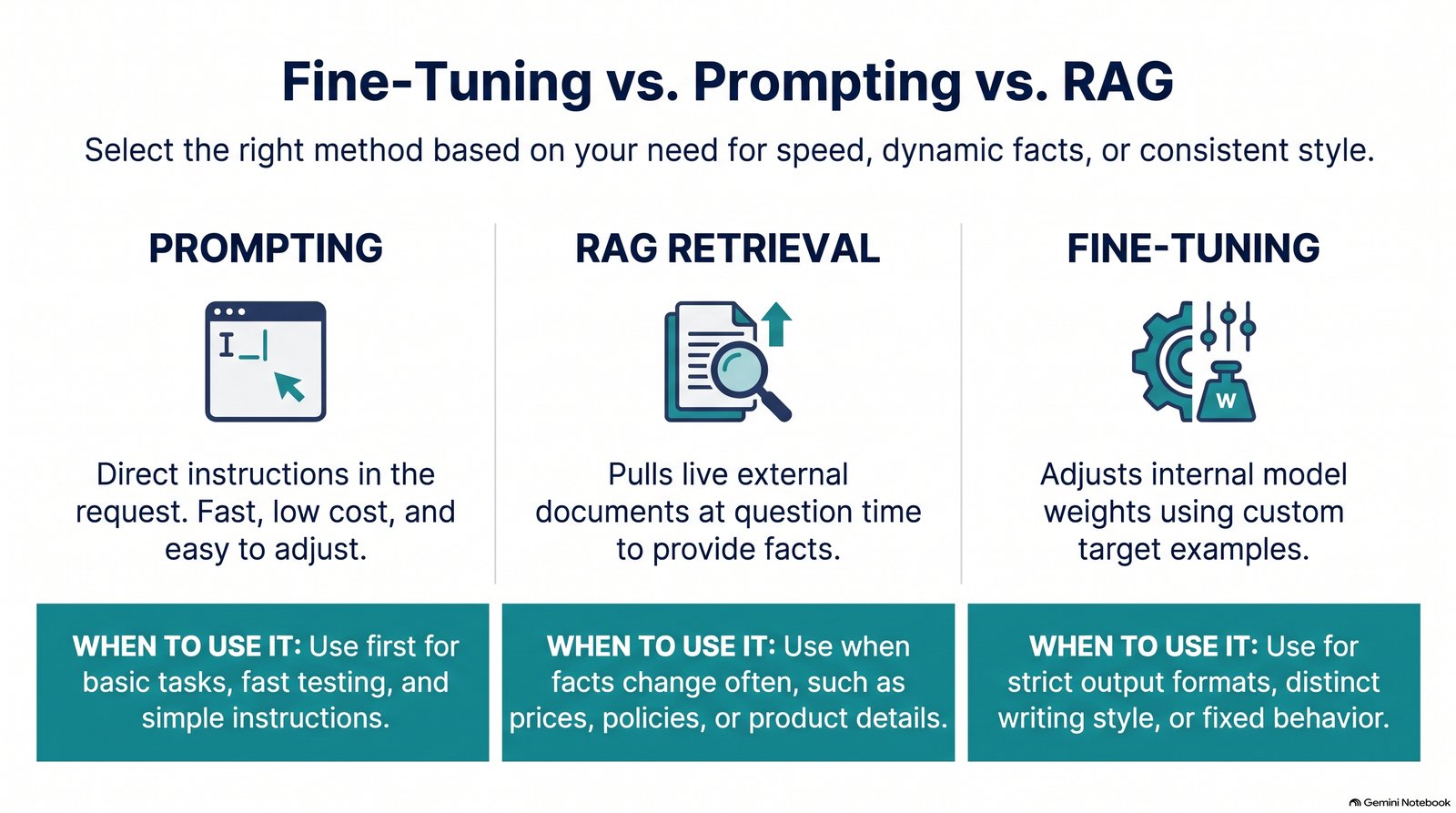
- Prompting: You give instructions and examples in the request. Fast, cheap, easy to change. Try this first.
- RAG (retrieval-augmented generation): The system looks up relevant documents at question time and gives them to the model. Best for facts that change, such as prices, policies or product details.
- Fine-tuning: The model learns a consistent behavior, such as a strict output format, a classification task or a house style, that’s hard to get from prompts alone.
OpenAI’s own accuracy guide follows the same order: start with prompts, add retrieval when the model lacks knowledge, and fine-tune when it needs to behave more consistently.
One warning: fine-tuning a model on your product facts doesn’t keep them current. When the facts change, the tuned model keeps repeating the old version until you train it again.
What this means for your brand in AI search
You can’t fine-tune ChatGPT, Gemini or Google’s AI Overviews to know your brand. Those models don’t learn from your corrections, either. Every answer comes from what the model memorized in training plus what it retrieves at question time. So the levers you control are the sources it retrieves: your own pages, and what trusted third parties say about you.
How we built our AI skills without fine-tuning
At Stradiji we use Claude skills for SEO and GEO work, including geo-master, our main GEO playbook, which reached version 3.9 on Oct. 19, 2026. None of them is a fine-tuned model. Each one is a set of written instructions and reference files that the model reads when the task starts.
That choice was deliberate. Search changes every week. Updating a text file takes minutes; retraining a model takes data, money and time, and it would be out of date by the next core update.
Run through our AI skills
We ran this term through the same skills we use on client sites
At Stradiji we built our own Claude skills for SEO and GEO work. Every glossary page passes through them before it goes live. Here is what each one flagged on this page.
Models don’t learn from you
A correction on your own site doesn’t retrain ChatGPT. The page says so plainly and points to the sources you can actually change.
Readers ask about LLMs, not radio tuning
“fine tuning llm” gets 880 US searches a month, more than “what is fine tuning” at 320 (Semrush, November 2026). The page is written for that reader.
Our own build decision
A six-part originality score with a publish threshold of 70. How we built our skills without fine-tuning is first-hand experience no generic definition has.
Are we cited?
We track an unbranded “fine-tune or RAG” prompt in AI search. Tracking since Nov. 4, 2026.
Want these skills run on your own site? Start with the free GEO Score Card below.
The one thing to do this week
Before you budget for fine-tuning, write down the exact problem. If the model gets facts wrong, you need better retrieval. If it gets the format or tone wrong after clear instructions and examples, fine-tuning may be worth testing.
Related terms
Frequently asked questions
Is fine-tuning the same as training a model?
It’s a short, second round of training on top of a model that’s already trained. Training from scratch takes vastly more data and computing power.
Can fine-tuning make ChatGPT recommend my brand?
No. You can only fine-tune your own copy of a model through an API. The public ChatGPT that your customers use isn’t affected.
Is RAG better than fine-tuning?
They solve different problems. RAG is better for current facts. Fine-tuning is better for consistent behavior. Many production systems combine both.
How much data do I need to fine-tune?
It depends on the task. Simple format changes can work with a few dozen good examples; harder tasks need hundreds or thousands. Quality matters more than quantity.
Sources
- Hu et al., “LoRA: Low-Rank Adaptation of Large Language Models,” Microsoft, 2021
- OpenAI, “Optimizing LLM accuracy” and fine-tuning documentation
- Stradiji, internal skill library (geo-master v3.9, Oct. 19, 2026)
