
An AI hallucination is when a language model presents false or made-up information as fact, in a confident tone. For brands, it most often shows up as a wrong price, a wrong founding year, a product feature that doesn’t exist or the wrong list of competitors.
Hallucination isn’t a software bug. It’s a result of how models are trained. In research OpenAI published in September 2025, the company argued that standard training and evaluation procedures “reward guessing over acknowledging uncertainty.” A lucky guess scores better than an honest “I don’t know,” so models learn to guess (OpenAI, September 2025).
Why AI hallucinations matter for your brand
When a model says something wrong about your brand, readers won’t think you said it, but they may believe it. A wrong price lands on your sales team. A wrong feature lands on support. A wrong competitor list lands on marketing.
There’s a legal side, too. In February 2024, British Columbia’s Civil Resolution Tribunal in Canada held Air Canada responsible after the chatbot on its website gave a passenger wrong information about a bereavement fare refund. The tribunal rejected the airline’s argument that the chatbot was a separate entity responsible for its own statements (American Bar Association, February 2024). What an AI tool on your own site says is on you.
How AI hallucinations happen
- Information gaps. If a model hasn’t seen enough consistent information about your brand, it fills the gap with guesses based on similar brands or general patterns.
- Conflicting sources. If an old directory listing, an outdated About page and a new press release disagree, the model may pick the wrong one.
- Name confusion. If your name looks like another brand, person or concept, the model may merge the two.
- Stale memory. The model presents old training data as current. The risk is highest for questions it answers without searching the web (no grounding).
The SEO and GEO connection
The strongest defense against hallucination is shared work between SEO and GEO: clear, consistent, sourced information. When the model searches the web, it should find your right page (crawlability, citation optimization). When it doesn’t, the right facts should already be in its memory (entity optimization, Wikidata, consistent profiles).
We ran into name confusion with our own brand. In August 2026, we asked Gemini about Stradiji with web search off. It didn’t recognize the brand, confused the name with Stradivarius and declined to answer. With search on, it described us correctly. That time, the model stepped back instead of making something up. But the same gap can turn into a wrong answer in another model or on another question.
What we’ve seen in the field
About 87% of the more than 100 websites we audited through September 2026 had no Wikidata entry, and about 3 in 4 had no Wikipedia article (The Three Doors of AI Visibility). Without records in the open knowledge bases a model can check, gaps are more likely to get filled with guesses.
When we trace wrong information, these are the first places we look: directory listings opened years ago and forgotten, PDFs with old prices, news stories from before a name or address change and social profiles that don’t match each other.
A practical playbook for AI hallucinations
- Ask on a schedule. Ask “What is X, what does it do, what does it cost, who are its competitors?” in more than one engine, with search on and off, and log the answers.
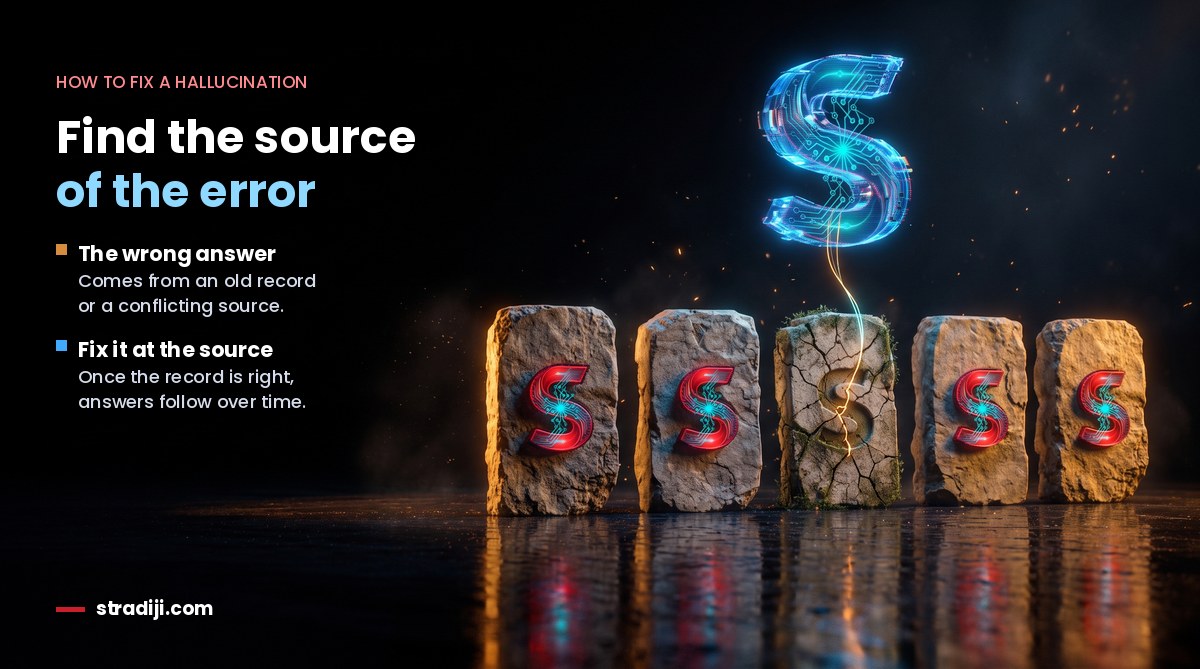
- Find the source. When you see a wrong fact, check the source list in search-on mode. A fix won’t last until you know where the error came from.
- Fix it at the source. Update the old directory listing, remove or redirect the old PDF, or ask the publisher to correct the story.
- State the truth plainly. Publish prices, features and company facts on your own site, clearly and with dates, as your single source of truth.
- Define your entity. Organization schema, sameAs links and a sourced Wikidata item help models match you to the right entity.
- Limit your own tools. Set up any chatbot on your site to answer only from approved sources, and to hand off to a person when it isn’t sure.
Further reading from AI authorities
- OpenAI: Why language models hallucinate (September 2025). Research on why training and evaluation methods produce hallucinations.
- Nature: Detecting hallucinations in large language models using semantic entropy (Farquhar et al., June 2024). A method that flags made-up answers by measuring uncertainty in meaning.
- NIST AI 600-1: Generative AI Profile (July 2024). The U.S. National Institute of Standards and Technology framework that defines hallucination (“confabulation”) as a risk.
- A Survey on Hallucination in Large Language Models (Huang et al.). A broad academic review that classifies hallucination types, causes and mitigation methods.
- Google Cloud: What are AI hallucinations? Google’s definition and its grounding-based approach to reducing them.
- Anthropic: Reduce hallucinations. Practical techniques, such as letting the model say “I don’t know” and grounding answers in quoted sources.
Related terms
Frequently asked questions
Can AI hallucinations be prevented completely?
No, but they can be reduced. Because models are trained in ways that reward guessing, hallucinations don’t disappear. The more clear, consistent, sourced information exists about your brand, the less a model needs to guess.
What should I do if a model gets facts about my brand wrong?
Ask the same question with search on and check the source list. Find where the wrong fact comes from and fix it there. Then publish the right information on your own site, clearly and with a date. The change can take weeks or months to show up.
Does grounding stop hallucinations?
It reduces them, but it doesn’t stop them. When a model searches the web, it rests on current sources. But if the sources are wrong, or the model summarizes a passage badly, errors can still happen.
Are we liable for what the chatbot on our site says?
That’s a legal question, and the answer varies by country, so ask your lawyer. Canada’s Air Canada decision (February 2024) is an important example of a company being held responsible for information its website chatbot gave.
