
Alphabet’s Q3: search growth slowed to 12% and AI Mode ads are coming. Five myths, data from two U.S. sites, 8 predictions for 2027. Run your baseline today.
Popular Posts
Latest Articles

Google Isn’t Losing Users. It’s Losing Clicks: AI Mode Ads, 5 Myths and 8 Predictions for 2027

Part of the GEO Roadmap › Stage 9: Ads inside AI answers
Summary: Google didn’t lose to AI. In Alphabet’s Q3 2026 results, revenue grew 25% and query growth hit a five-year high. What Google is losing isn’t users. It’s clicks: search revenue growth slowed from 19% to 12% in three quarters, and for the first time Google admitted that AI Mode brings lower monetization. It announced the fix on the same call: ads inside the answer. By Google’s own data, sponsored and organic product listings in AI Mode already get similar click-through rates. In 2027, the thing to measure isn’t rankings. It’s whether you’re there when the decision gets made.
Below: what Alphabet’s numbers actually say, five data points that break five of our industry’s favorite assumptions (two of them from our own Search Console work), why Google is getting ready to sell the “decided click,” my eight predictions for 2027 with probabilities, and a 30-minute baseline you can run this week.
On Oct. 28, 2026, Alphabet reported its third-quarter results. The next day the stock fell about 13%, wiping out more than $500 billion, the largest one-day loss in market value in the company’s history. Two lines went around X: “Google lost to AI” and “Google is sending the bill to advertisers.”
Both lines are half right. When I read the numbers, I found the Google side of exactly what we had measured a week earlier in 12 months of GA4 data from 35 sites: AI traffic was just 1.29% of Google organic, yet on 8 of the 10 sites with clean conversion tracking, AI visitors bought more, at a median of 1.64 times. Five of our industry’s favorite assumptions crack in the same table.
The thesis: Google isn’t losing users. It’s losing clicks.
Query growth is at a five-year high and revenue grew 25%. What Google is losing isn’t users. It’s clicks. For the first time, Philipp Schindler, Google’s chief business officer, admitted that AI Mode brings “lower monetization,” because the answer does the comparing before anyone clicks.
That’s the Google side of our 1.64x: fewer clicks, but a visitor who has already decided. Now Google wants to sell that decided click back to us with ads inside the answer.
Everyone is arguing about traffic and revenue. The real question is where the decision gets made, and whether you’re there when it happens.
1. The numbers: Revenue didn’t fall. The value of a click did.
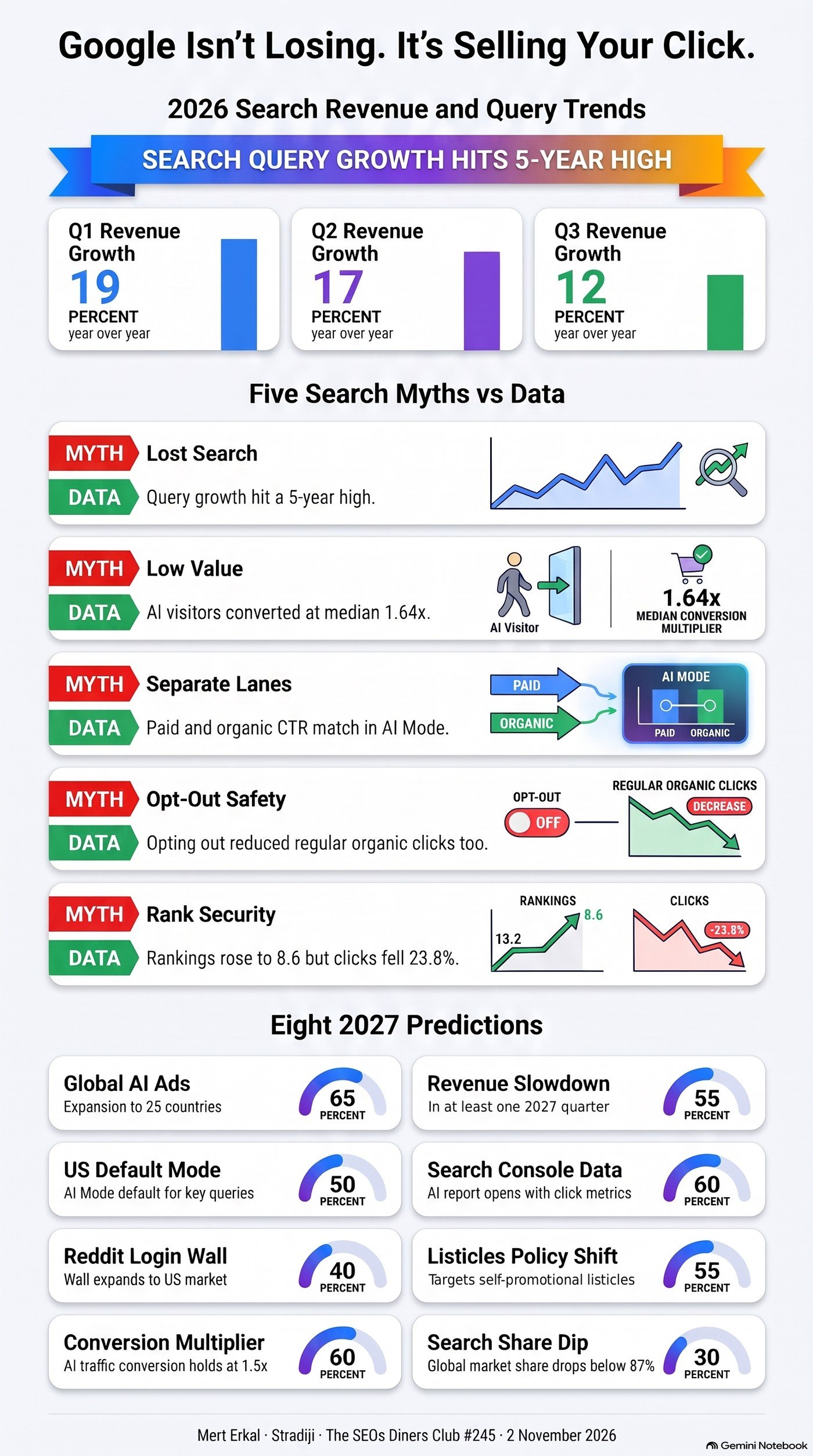
First, a correction. Google’s revenue didn’t drop. Alphabet grew quarterly revenue 25% to $127.6 billion. What dropped was the growth rate of search revenue:
| Quarter | Search revenue | Year-over-year growth |
|---|---|---|
| Q1 2026 | $60.4 billion | 19% |
| Q2 2026 | $63.3 billion | 17% |
| Q3 2026 | $63.4 billion | 12% |
Source: Alphabet quarterly results, as compiled by Relevant Audience.
Search came in roughly $1.6 billion below expectations. Schindler listed four drivers: currency (the largest), some retail advertisers in Asia-Pacific pulling back, the end of the World Cup boost, and AI Mode, where strong query growth “had an impact because of the lower monetization.”
Duane Forrester sorted that list neatly: currency, the World Cup and the trade-rule change are temporary. AI Mode is the only driver that grows every quarter. Using Alphabet’s constant-currency tables, he estimates currency explains perhaps one or two of the five points search growth lost. And search wasn’t the only reason the stock fell: free cash flow turned negative, and capital expenditure reached $51.3 billion for the quarter.
The fix came on the same call. AI Mode ads are scaling in 10 markets: Australia, Canada, India, Kenya, Malaysia, New Zealand, Nigeria, Pakistan, the Philippines and Singapore. Brazil, Mexico and the U.K. come next in Q4, and multi-turn ads on follow-up questions are coming in the U.S. For now, AI Mode ads run in English only.
2. Five myths, five data points
| Myth | What the data says |
|---|---|
| “Google lost to AI.” | Query growth is at a five-year high, and global search share is 89.94%. Users aren’t leaving. They’re not clicking. |
| “A channel that sends few clicks doesn’t matter.” | Across 35 sites, AI visitors bought more on 8 of 10, at a median of 1.64x. |
| “Paid and organic compete in separate lanes.” | In AI Mode, sponsored and organic product listings already get similar click-through rates. |
| “Opt out of AI Overviews and you’ll get your clicks back.” | In Cyrus Shepard’s test, regular organic clicks fell too. |
| “Track your rankings and the rest follows.” | On two of our U.S. sites, rankings and clicks moved in opposite directions. |
Myth 1: “Google lost to AI.”
Data: Sundar Pichai says Google’s year-over-year query growth is the highest in five years. AI Mode passed 1 billion monthly users in May. On StatCounter, Google’s global search share was 89.94% in September 2026, with Bing at 5.29%.
Users aren’t leaving. They’re asking more and clicking less. That’s not a defeat. It’s a change of model: Google is becoming an answer engine, and answer engines struggle to sell clicks. Google’s problem isn’t a rival. It’s its own answer.
A footnote: Google hasn’t said how it counts a query. AI Mode conversations are multi-turn. If every turn counts, record query growth arrives on its own as conversations get longer.
Myth 2: “A channel that sends few clicks doesn’t matter.”
Data: In our 35-site study, AI traffic was 1.29% of Google organic, yet it bought more on 8 of 10 sites, at a median of 1.64x.
Put the two facts side by side. Google says AI Mode earns less because people no longer open 10 tabs to compare. The answer does the comparing. What Google loses is the comparison click. What you win is the visitor who has already decided. Same coin, two sides. As I showed in ChatGPT Decides Before It Searches, the model often picks the brands it will recommend before it runs a single search.
Kevin Indig’s data completes the picture: across roughly 10,000 domains each in the U.S. and France, organic visits fell 13.2% in the U.S. and 24.4% in France between August 2024 and August 2026, while U.S. paid search traffic grew 21%. Kevin is clear that he didn’t prove causation. But the direction is plain: the click isn’t disappearing. It’s moving to the auction.
Myth 3: “Paid and organic compete in separate lanes.”
Data: One sentence in Google’s own announcement may be the most important of the whole call. Based on U.S. data from Aug. 20 to Sept. 3, click-through rates are already similar between sponsored and organic product listings in AI Mode.
On a classic results page, ads sat on top and organic below. They behaved differently, and we built strategies on that split. Inside the answer, the split disappears. An answer has only a few places where a brand can appear, and Google is putting some of them up for sale to close its revenue gap. If both get clicked at the same rate, advertisers have every reason to buy those places. Organic visibility doesn’t vanish. It now shares a shelf with inventory that has a revenue target.
In e-commerce, you win the organic slot on that shelf with product data. In our Shopify SEO checklist, 22 of 25 U.S. Shopify stores published agent profiles, but only 5 of the 23 product pages we could read had a GTIN.
Myth 4: “Opt out of AI Overviews and you’ll get your clicks back.”
Data: Cyrus Shepard tested this on his own site. He used Google’s opt-out controls to remove the site from AI Overviews and AI Mode. AI impressions were about 8% of the total, with an estimated CTR of 0.9%. When he opted out, regular organic clicks fell too, which he called the most surprising finding.
I understand the “they’re using us, let’s leave” reflex. I feel it too. But this small, single-site test suggests there’s no exit door.
Myth 5: “Track your rankings and the rest follows.”
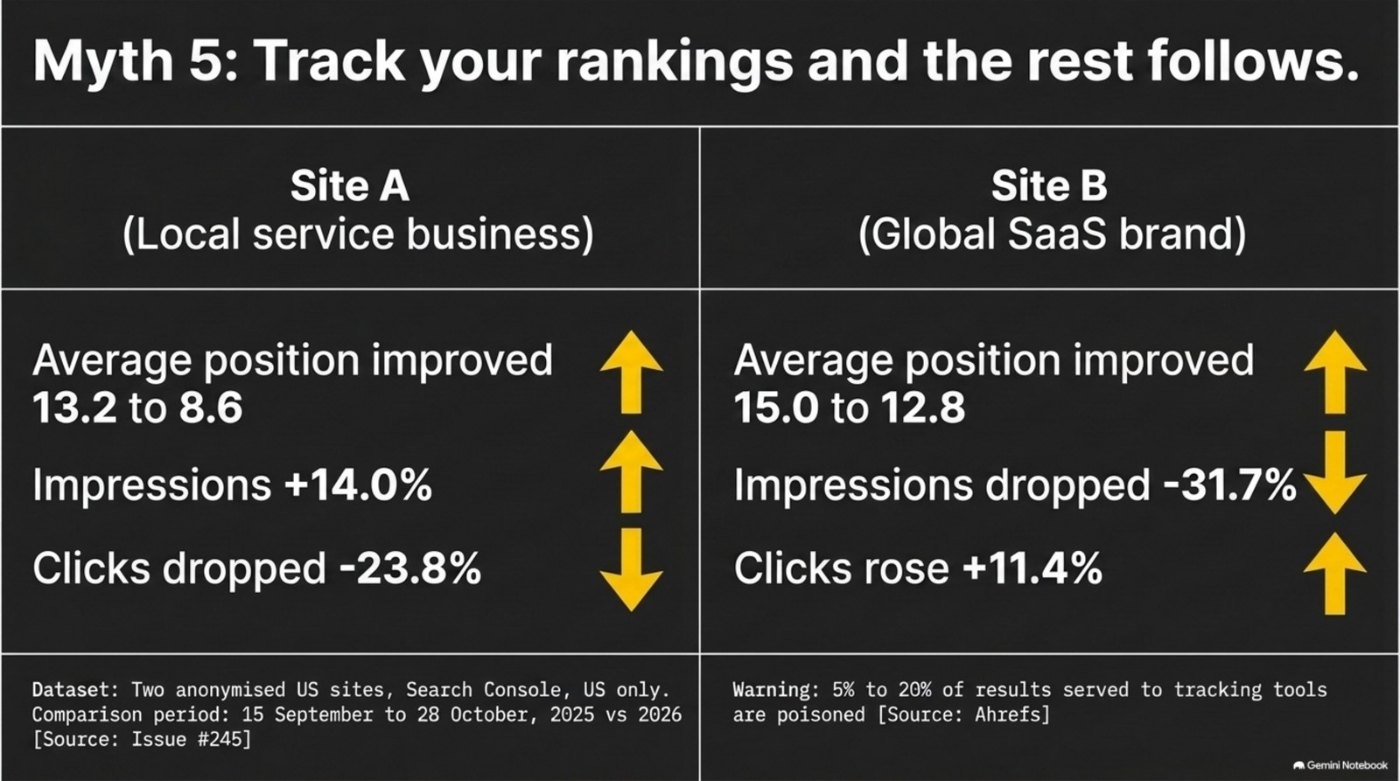
Data: Two U.S. sites from our own Search Console work, anonymized. Same window, Sept. 15 to Oct. 28, 2025 versus 2026, U.S. traffic only.
| Site | Average position | Impressions | Clicks |
|---|---|---|---|
| Site A (local service business) | 13.2 to 8.6 | +14.0% | -23.8% |
| Site B (global SaaS brand) | 15.0 to 12.8 | -31.7% | +11.4% |
Source: Google Search Console, Sept. 15 to Oct. 28, 2025 and 2026, U.S. only.
Site A looks brilliant in a ranking report: higher positions, more impressions. Yet it lost a quarter of its clicks. Site B looks bad: a third of its impressions gone. Yet clicks grew 11%. Which one is winning? Anyone reading rankings is applauding the wrong site.
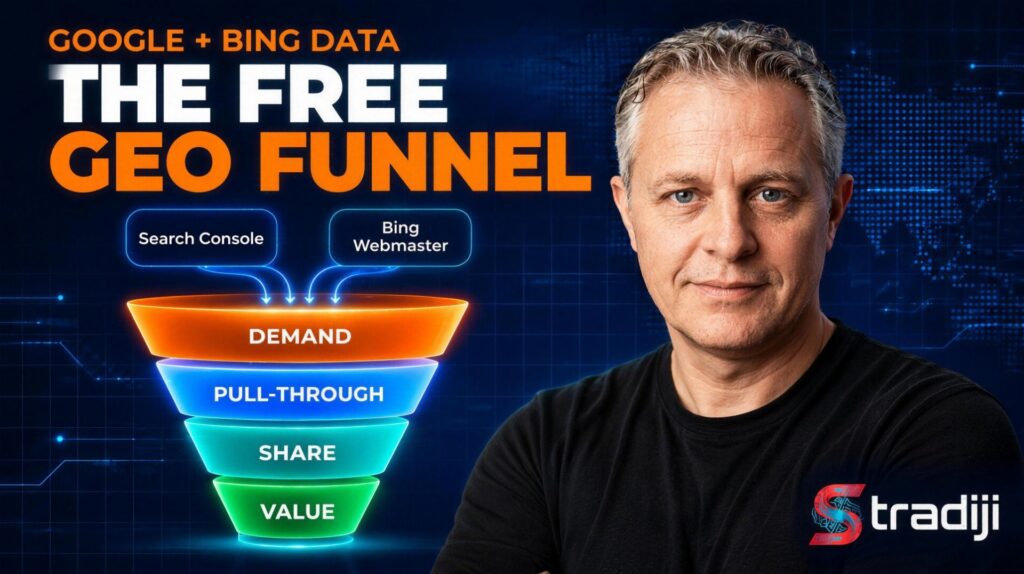
The measuring tools are shaking too. According to Ahrefs, 5% to 20% of the results Google serves to tracking tools are “poisoned” results real users never see. And on Oct. 28, Semrush told enterprise customers it will stop tracking Copilot from Nov. 9 because of Microsoft’s access changes. Measuring from the outside is getting harder. What’s left is first-party data: Search Console, Bing’s AI reports, your own GA4 and your own tests. We showed how to combine them in a free GEO funnel from Search Console and Bing data.
3. My read: Google is getting ready to sell the decided click
For 25 years there was an unwritten deal between Google and site owners: we create, Google crawls, and in return it sends visitors. AI Overviews and AI Mode quietly erased our side of that deal. The answer is built from our content, and the visitor stays on Google. Reddit CEO Steve Huffman said it plainly: AI Mode doesn’t drive traffic, not to Reddit and, as far as he knows, not to anyone. Reddit will test a logged-in-only version in some markets outside the U.S.
I’m not neutral here. It has bothered me for years that answers built on site owners’ work send those sites so little. But I want to keep that frustration inside the data.
And the data says this: in the new model, the most valuable thing is the single click that comes after the answer, from a user who has already decided. Google knows it, and it’s putting an ad in front of that click.
Ads could backfire. What people liked about AI Mode was one clean answer. If that answer turns into a billboard, there’s one more reason to switch to ChatGPT, Perplexity or the Gemini app. Advertisers are squeezed too. A model that pushes users and advertisers at the same time won’t stay comfortable for long. Google won’t end, but on this path it could shrink.
In May, Lily Ray warned of a “devastating” effect on the open web. Glenn Gabe, reacting to multi-turn ads, said AI Mode’s path to becoming the default continues. Both may be right: AI Mode is Google’s future and its most expensive experiment.
One robots.txt note: The same week, OpenAI, Google, Microsoft and Anthropic announced a shared robots.txt training signal (__usage_ai-training). Crawling, training and being an answer source are three different things. Watch out: Google will read this signal like a Google-Extended block, which also covers being cited in Gemini.
4. The questions I hope we ask in 2027
The question I still hear most in client meetings is “What position are we?” All five myths grow from it. In 2027, it’s time to let it go. Here’s what I hope we talk about instead:
- Instead of “What position are we?”: “In how many of our commercial questions does AI recommend us?”
- Instead of “How many citations did we get?”: “In how many of the answers that cite us does our name appear?” We showed the gap between being cited and being recommended in I Asked AI for the Best GEO Agency.
- Instead of “What’s the search volume?”: “What question does our customer ask at the moment of decision?” AI Mode queries are three times longer than classic searches, and every user sees a different answer.
- Instead of “Why did traffic drop?”: “Why do the visitors we get buy more, and does our page keep the promise the answer made?”
Rank tracking won’t disappear. It will become a diagnostic tool. “We moved from 7 to 3” is more comfortable. But Site A’s numbers show that comfortable and correct are no longer the same thing. We traced where the ranking report came from, year by year, in 35 years of SEO evolution.
5. Eight predictions for 2027, with probabilities
The honest way to make predictions is to show the scorecard for the old ones. Here’s what I wrote in 2026:
- March 22: “AI Mode will be Google’s next ad machine.” ✅ Happened, scaling in 10 markets.
- March 22: “Personal Intelligence will bring personalized ads.” ✅ Happening. Google’s Oct. 27 privacy update lets connected apps shape AI Mode ads.
- March 22: “AI Mode will become the default search at I/O in May.” ❌ Didn’t happen. Google said in May and again in June that AI Mode is not the default. Wrong timing, right direction.
- April 11: Take Pichai’s “search becomes an agent manager” vision seriously. 🟡 On the way: search agents were announced at I/O, and the first ones opened to Ultra subscribers in June.
Knowing the direction is easy. Knowing the timing is hard. So this time I’m adding probabilities. All are personal estimates, and I deliberately left out anything that has already happened.
| # | Prediction (2027) | Probability | What to do now |
|---|---|---|---|
| 1 | By the end of 2027, AI Mode ads run in at least 25 countries and in at least five languages other than English. Today: 10 countries, 13 by Q4, English only, while AI Mode itself runs in 200+ countries and roughly 100 languages. | 65% | Measure and record your organic visibility before ads arrive. |
| 2 | In at least one quarter of 2027, search revenue growth drops to single digits. The trend is 19%, 17%, 12%. | 55% | Note your cost per click for the last 12 months. |
| 3 | AI Mode becomes the default in the U.S. for at least one query type. Duane Forrester puts the end of the results page as the default in 2028 to 2030. I think a partial switch starts in 2027. | 50% | Save the AI Mode answers to your commercial questions every month. |
| 4 | Search Console’s AI report opens to everyone and adds click data. Since June it has been available to some sites only, with impressions only, and without separating AI Overviews from AI Mode. | 60% | If you have the report, screenshot it every month. |
| 5 | Reddit brings its login wall to the U.S. U.S. logged-out daily users fell from 30.1 million to 27.3 million between Q2 and Q3. | 40% | List the AI answers in your category that lean on Reddit. |
| 6 | By mid-2027, Google announces a policy or confirmed update that names self-promotional “best of” listicles. Lily Ray found AI Overviews cited such lists about 38% less in September than in June. Google hasn’t confirmed anything. | 55% | If you have one, remove it or tie it to a neutral method. |
| 7 | The AI visitor’s conversion advantage holds: at least 1.5x Google organic at the end of 2027. I’ll re-measure the same 35 sites next year. | 60% | Set up AI sources as their own channel group in GA4. |
| 8 | Google’s global search share falls below 87% by the end of 2027. Today it’s 89.94%. The irony: users who leave Google Search may land on another Google product, Gemini. | 30% | Measure your visibility in ChatGPT and Gemini, not just Google. |
I’ll grade all eight here on Nov. 1, 2027, misses included.
You can explore the full slide deck and infographic in this week’s NotebookLM notebook.
This week’s one step: A 30-minute pre-ads baseline
- Ask AI Mode five of your commercial questions. Note three things separately: Are you recommended? Are you only cited? Is there an ad next to you? That’s your pre-ads baseline.
- In GA4, compare the conversion rate of AI visitors with organic. Our median was 1.64x. What’s yours?
- Put rankings and clicks side by side in Search Console. Compare the last six weeks with the same period last year. Are you Site A (rankings up, clicks down) or Site B (the opposite)?
- Add a column to your ranking report: “Does AI recommend us for this query?” A month later, check which column tracks sales more closely.
- Don’t rush to change robots.txt. Remember Shepard’s test: opting out doesn’t always mean protecting yourself.
If you’re in the U.K.: AI Mode ads are due in Q4. Run this baseline before they arrive.
Closing
A week ago we said “not traffic, sales.” This week Google said the same thing to Wall Street in its own words: the better the answer, the fewer the clicks. Everyone read that as Google’s defeat. I read it as proof that the decision now happens before the click. Your traffic can shrink while your sales don’t.
For 25 years Google helped people find what they were looking for, through our sites. Now it gives the answer itself and gets ready to sell the last click. And for 25 years we asked, “What position are we?” Let’s retire that question in 2027.
Which of the five myths do you still believe? Bring your data, and I’ll add your objection to the 2027 scorecard. If you’d like to see which commercial questions AI recommends you for, where it only cites you and where you stand before the ads arrive, that’s where our GEO consulting work starts.

These May Also Interest You



The SEOs Diners Club · Weekly newsletter
Every Monday: what's actually moving in SEO and AI search
Mert Erkal breaks down one big shift each week, backed by real tests and data.
Free · 245 weekly issues since 2022 · Unsubscribe anytime


