Citation optimization is the work of raising the odds that your pages show up as sources under ChatGPT, Gemini, Perplexity and Google AI Overviews answers. The goal is not a ranking. It’s being one of the sources the answer rests on.
Being mentioned and being cited are different things. A model can name your brand while citing a competitor’s comparison page as the source. Citation optimization is about your page sitting in that source line.
Why citation optimization matters for your brand
The source link under an AI answer is one of the few doors left open in zero-click search. When readers want more, they click it. And the cited page shapes how the model describes you. If the sentence comes from your page, the story is yours.
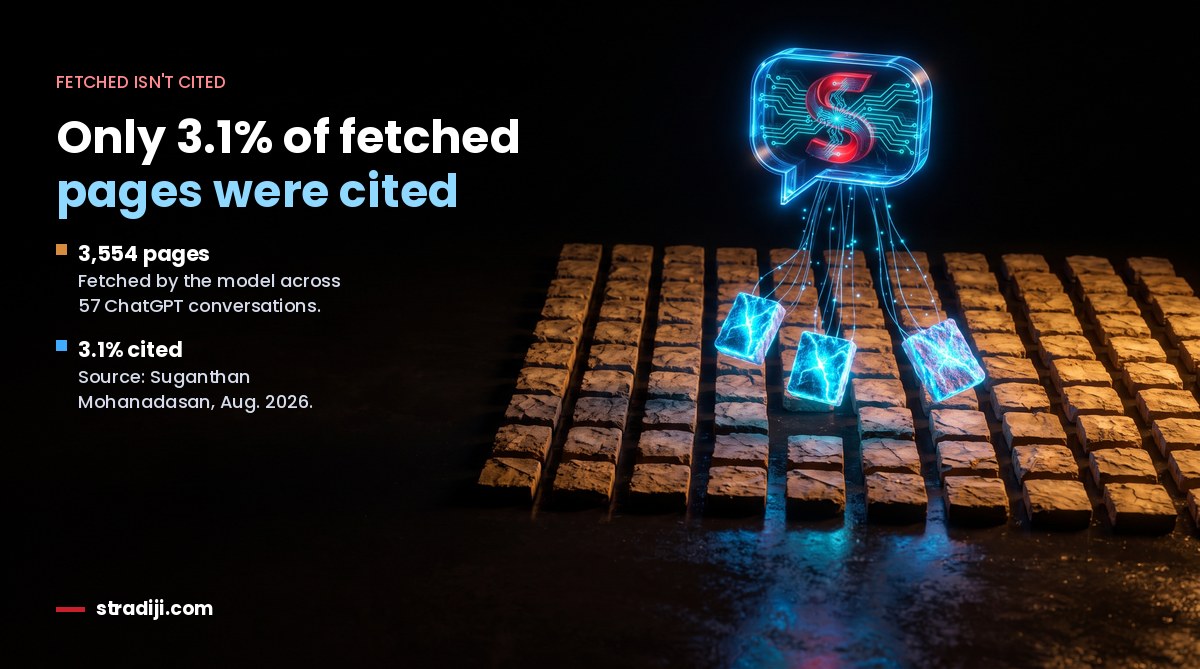
The competition is steep. In a labeled set of 3,554 pages from 57 ChatGPT conversations, Suganthan Mohanadasan found that only 3.1% of the pages the model fetched were cited in the answer (Suganthan Mohanadasan, August 2026). Getting fetched isn’t enough. You have to get picked.
How citation optimization works
Models cite passages, not whole pages. The same study surfaced three factors that separate cited pages from the rest:
- Position within your domain. A site’s top-matching page was cited 5.2% of the time. Pages in sixth place or lower were cited 0.3% of the time.
- No page stacking. Two tightly matched pages for the same question look like the sweet spot. Six or more means you compete with yourself.
- Relevance. It gets you onto the shortlist, but it doesn’t win the citation on its own. A clear passage with proof does.
Research points the same way. In the GEO paper from Princeton and partners (November 2023, KDD 2024), adding sources, quotations and statistics to content raised visibility in generative engine answers by up to 40%.
The SEO and GEO connection
Citation optimization is SEO’s content-quality work applied to AI answers: crawlable, fast, clear, sourced pages. The difference is in measurement. You check the source list under the answer, not your rank. The second difference is proof. “We’re the best in the industry” doesn’t get cited. Documented proof does.
In July 2026, the only bank page cited in Google’s AI answer to “best credit card” in Turkey was Yapı Kredi’s Worldcard. The page didn’t praise itself. It documented that Worldcard was the first and only Turkish card on The Banker’s list of the world’s 10 most valuable credit cards.
What we’ve seen in the field
Of the more than 100 websites we audited through September 2026, about two thirds lacked a citation-ready Q&A structure, and about half had no independent reputation signal (The Three Doors of AI Visibility). The blockers we see most:
- Five or six pages covering the same topic. The model can’t tell which to pick, and often picks none.
- Numbers with no source. The model takes the sourced version of the same number from another site.
- Proof locked in a PDF or an image. Proof that isn’t in plain text doesn’t get read.
A practical citation playbook
- Pick target questions. Choose the 20 to 25 questions closest to a buying decision.
- Give each question one owner page. Merge or redirect other pages that answer the same question.
- Write the passage. Put a stand-alone, sourced, dated answer paragraph at the top of the owner page.
- Document the proof. An award, an independent ranking, a client result or your own measurement, with its source, in plain text.
- Measure the source list. Ask the questions in at least two engines on different days. Log which of your pages gets cited and which competitor page gets cited instead.
Related terms
- AEO (answer engine optimization)
- GEO (generative engine optimization)
- Grounding
- AI visibility
- E-E-A-T
Frequently asked questions
What’s the difference between a mention and a citation?
A mention is your brand name appearing in the answer. A citation is your page listed as a source under it. Measure and report them separately.
How do I measure my citation rate?
Run the same question set in at least two engines on different days and log the source list for each answer. Count how many answers cite you, and with which page. One test proves little. Repeated tests do.
Will more pages raise my odds of being cited?
Usually not. Many pages for one question means competing with yourself. One strong page with supporting content that links to it works better.
If I rank myself first on my own list, will I get cited?
Probably not. In Lily Ray’s review of 100 B2B queries, the brand that put itself first on its own list was not recommended by the AI answer in 224 of 323 cases, or 69% (Search Engine Land, June 2026).
