
Natural language processing (NLP) is the branch of AI that lets computers read human language: who is being talked about, what they did and how the ideas connect. In SEO, NLP is how Google and AI assistants decide what your page is about. Pages that state clear facts about clearly named things are easier for them to understand, rank and quote.
How NLP works, in three steps
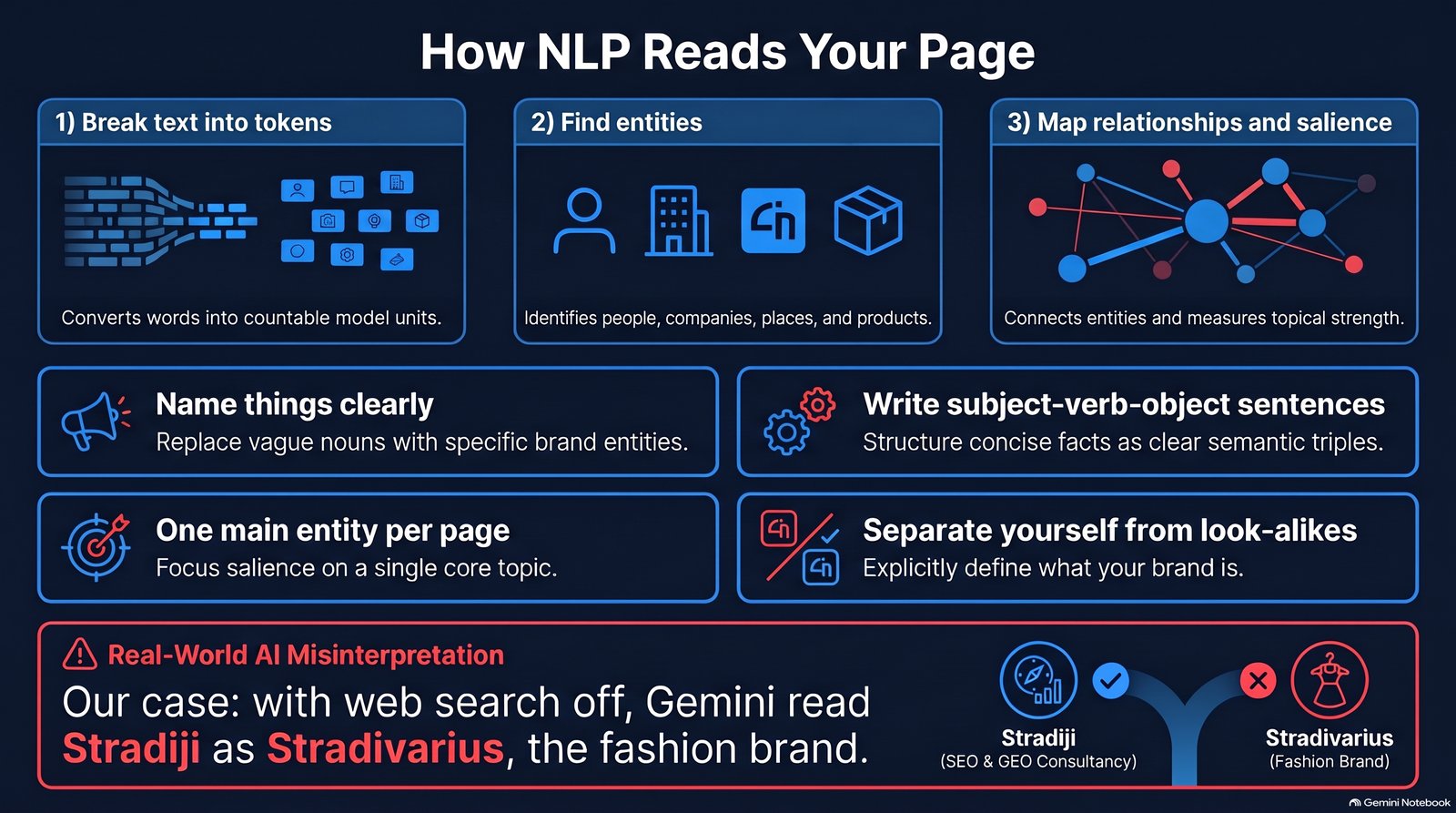
- Break the text into pieces. Words and parts of words become tokens the model can count.
- Find the things. The model spots entities, such as people, companies, places and products, and links them to what it already knows.
- Work out the relationships. It figures out who did what to whom, and how strongly the page is about each entity. Google’s Cloud Natural Language API calls this strength “salience.”
NLP in Google Search: a short history
Google started using BERT in Search in October 2019 and said it affected about 1 in 10 English queries in the US. BERT helped Google read small words like “for” and “to” that change a query’s meaning. In 2021 Google introduced MUM for more complex tasks. Today’s AI Overviews and AI Mode run on Gemini models that do the same job at a larger scale: reading pages, then writing answers from them.
What NLP means for your content
- Name things clearly. “Our tool” is vague. “Stradiji’s GEO Score Card” is an entity a machine can hold on to.
- Write simple subject-verb-object sentences. “Google launched AI Overviews in May 2024” is a fact a model can lift. These sentences are called semantic triples.
- Keep one main entity per page. If a page is about five things equally, salience is spread thin and none of them wins.
- Separate yourself from look-alikes. If your name resembles another brand, say plainly what you are and what you’re not.
One warning: NLP is not a keyword density game. Repeating a term doesn’t make a page more relevant. Clear facts about named things do.
What happened to our own brand
In August 2026 we asked Gemini about Stradiji with web search turned off. It didn’t know us. Worse, it read “Stradiji” as “Stradivarius,” the fashion brand, and declined to answer. With search turned on, it found us and even got our founding year right.
That’s an NLP error, not a ranking one. The model “corrected” a name it didn’t recognize into one it did. The fix isn’t more keywords. It’s a clear category plus name (“SEO and GEO consultancy Stradiji”), consistent alternate names in structured data, and a Wikidata record that tells machines we’re a separate entity.
This page had its own version of the problem. In the 90 days before this update, the query “nlp meaning seo” showed it 269 times at an average position of 16.8, with zero clicks (Search Console). The old page answered the computer science question. Searchers wanted the SEO one, so we rewrote it.
Run through our AI skills
We ran this term through the same skills we use on client sites
At Stradiji we built our own Claude skills for SEO and GEO work. Every glossary page passes through them before it goes live. Here is what each one flagged on this page.
Name collisions are NLP problems
When a model mixes your brand up with a similar name, it usually happens in memory, not in search results. Test with web search on and off.
At least three clear facts
Every section of this page has at least three subject-verb-object sentences a model can quote without context.
Readers search “NLP in SEO,” not just “NLP”
“nlp meaning seo” brought this page 269 impressions in 90 days (Search Console). So the page answers the SEO question, not the computer science one.
Could ChatGPT write this?
A six-part originality score with a publish threshold of 70. The Stradivarius mix-up is our own evidence.
Want these skills run on your own site? Start with the free GEO Score Card below.
The one thing to do this week
Paste your homepage’s first paragraph into Google’s Cloud Natural Language API demo. Look at which entity it ranks highest by salience. If it isn’t your brand or your core service, rewrite that paragraph.
Related terms
Frequently asked questions
Is NLP a Google ranking factor?
Not as a single factor. NLP is how Google understands pages and queries, which shapes every ranking decision. You don’t optimize for NLP directly; you write so it can understand you.
What is the difference between NLP and an LLM?
NLP is the whole field of making machines work with language. A large language model (LLM) is one type of NLP system, trained on huge amounts of text to predict and generate words.
Do I need NLP tools to write SEO content?
No. They help you check your work, for example by showing which entities a page emphasizes. Clear writing about named things does most of the work.
What are semantic triples?
A semantic triple is a subject, a verb and an object, such as “Google launched BERT.” These short facts are easy for search engines and AI assistants to extract and quote.
Sources
- Google, “Understanding searches better than ever before” (BERT), Oct. 25, 2019
- Google, “MUM: A new AI milestone for understanding information,” May 2021
- Google Cloud Natural Language API documentation (entity analysis, salience)
- Stradiji, Gemini test with and without web search, August 2026
