
An embedding is a list of numbers, called a vector, that represents the meaning of a piece of text, an image or another item. Texts with similar meanings get vectors that sit close together, even when they share no words. Search engines and AI assistants use embeddings to match a question with the passages most likely to answer it.
How embeddings work
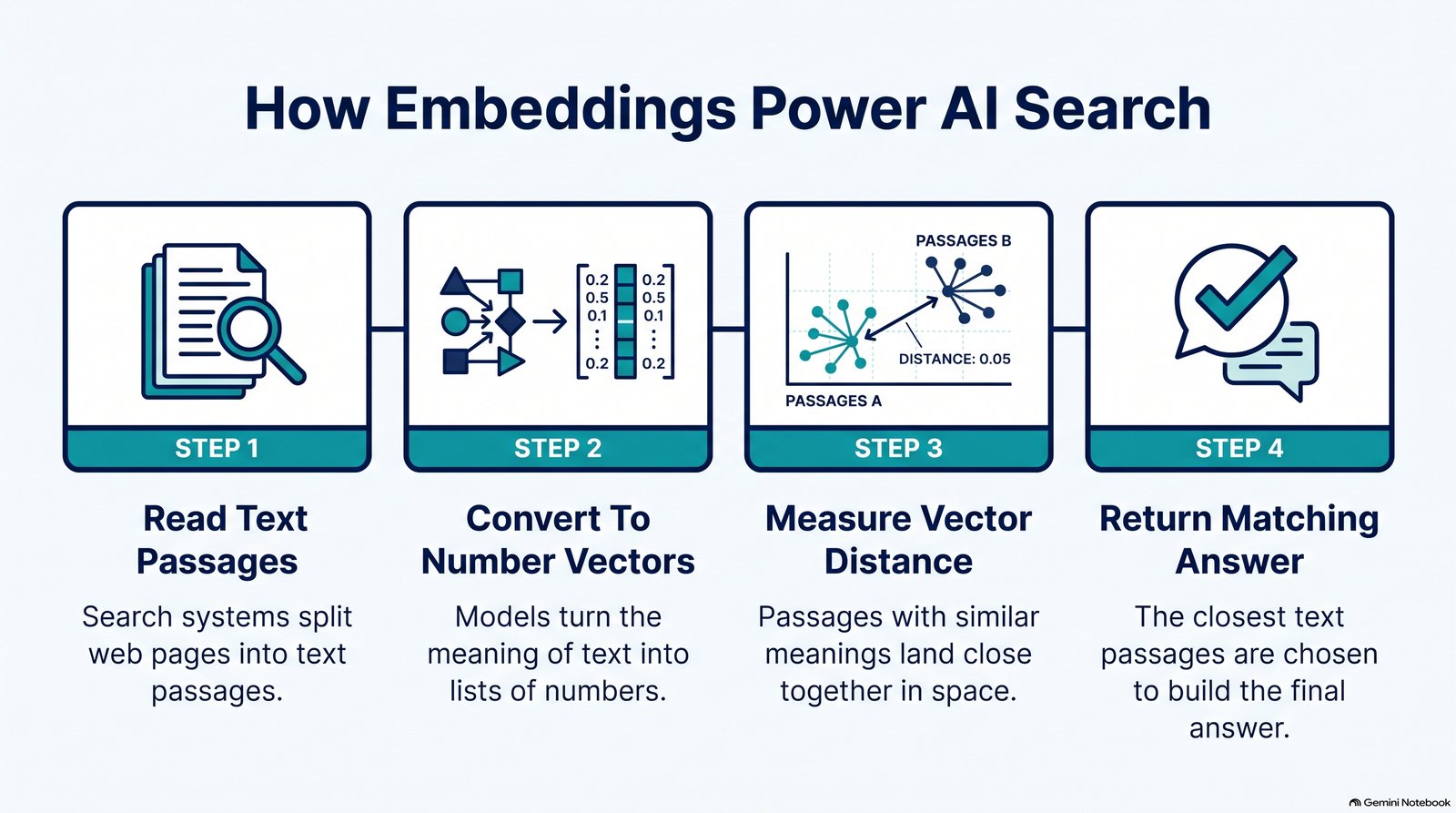
An embedding model reads a sentence and outputs a vector with hundreds or thousands of numbers. Each number captures some part of meaning the model learned during training. You can’t read one number on its own, but you can measure the distance between two vectors.
That distance is the whole trick. “How do I reset my router” and “my Wi-Fi box needs a restart” share almost no words, but their embeddings land close together. A keyword index would miss the match. An embedding index finds it.
Google’s word2vec, published in 2013, made the idea popular for single words. Today’s models, such as OpenAI’s text-embedding-3 family and Google’s Gemini embedding models, create embeddings for whole sentences and passages.
Why embeddings matter for AI search and SEO
- AI answers are built from passages. Retrieval systems split pages into chunks, embed each chunk and compare them with the embedded question. The closest chunks become candidates for the answer.
- Meaning beats exact match. A passage that answers the question clearly can win even if it doesn’t repeat the query word for word.
- Embeddings are usually computed ahead of time. Systems embed pages when they crawl them, not when you ask. A fix you publish today reaches AI answers only after the page is crawled and embedded again.
- Similar pages compete with each other. If two of your pages produce nearly the same embedding, you’re splitting signals between them.
One warning: you can’t “optimize the vector” directly. The only lever you control is the text: one clear topic per passage, the answer close to its question and no filler that dilutes the meaning.
What we found in our own glossary
While preparing this page, we checked which of our glossary URLs earn Search Console impressions. Three pairs stood out: “what is entity SEO” and “what is entity optimization,” “what is knowledge panel” and “what is Google Knowledge Panel,” and two separate pages explaining SERPs. Each pair says almost the same thing, so each pair would sit almost on top of each other in an embedding space. Both pages get shown, neither page wins.
That’s the most practical use of embeddings for most sites: not a ranking trick, but a way to find your own near-duplicates before search engines and AI systems have to pick for you.
Run through our AI skills
We ran this term through the same skills we use on client sites
At Stradiji we built our own Claude skills for SEO and GEO work. Every glossary page passes through them before it goes live. Here is what each one flagged on this page.
AI search reads passages, not pages
Each section of this page answers one question on its own, so any single chunk can be retrieved and quoted without the rest.
Closest to page one
This page already ranks around position 14 in the US, and 7.6 for “embedding” (Search Console, 90 days). A clearer answer is the fastest win of the five terms we refreshed.
Our own duplicates
A six-part originality score with a publish threshold of 70. The three page pairs above are evidence a general explainer can’t copy.
Are we cited?
We track an unbranded “what are embeddings” prompt in AI search. Tracking since Nov. 4, 2026.
Want these skills run on your own site? Start with the free GEO Score Card below.
The one thing to do this week
List the pages on your site that target the same question with different wording. If two pages answer the same thing, merge them into the stronger one and redirect the other. Screaming Frog can now generate embeddings for every page through an AI provider’s API and flag near-duplicates for you.
Related terms
Frequently asked questions
What is the difference between an embedding and a keyword?
A keyword is an exact string of letters. An embedding is a numeric representation of meaning. Keyword matching finds pages that use the same words; embedding matching finds pages that mean the same thing.
What is a vector embedding?
It’s the same thing. “Vector” refers to the format, a list of numbers. Embeddings are always vectors, so the two terms are used interchangeably.
Does Google use embeddings in Search?
Yes. Google has described using neural matching and models such as BERT to understand meaning beyond keywords. Its AI features also retrieve passages by meaning before writing an answer.
Can I see my page’s embedding?
You can create one yourself with an embedding API from OpenAI, Google or others, or through tools like Screaming Frog. You’ll get a list of numbers that’s only useful when compared with other embeddings.
Sources
- Mikolov et al., “Efficient Estimation of Word Representations in Vector Space” (word2vec), Google, 2013
- OpenAI, embeddings documentation (text-embedding-3 models)
- Google, “How AI powers great search results” (neural matching, BERT)
- Stradiji, Search Console data for stradiji.com glossary URLs, Aug. 1 – Nov. 2, 2026
