
Give your team an AI teammate that remembers the work
Hand Claude the weekly report, the meeting recap and the content plan. You set the rules and you sign off on everything. We run our own SEO and GEO client work this way, and we build the same system for your team, with your data.
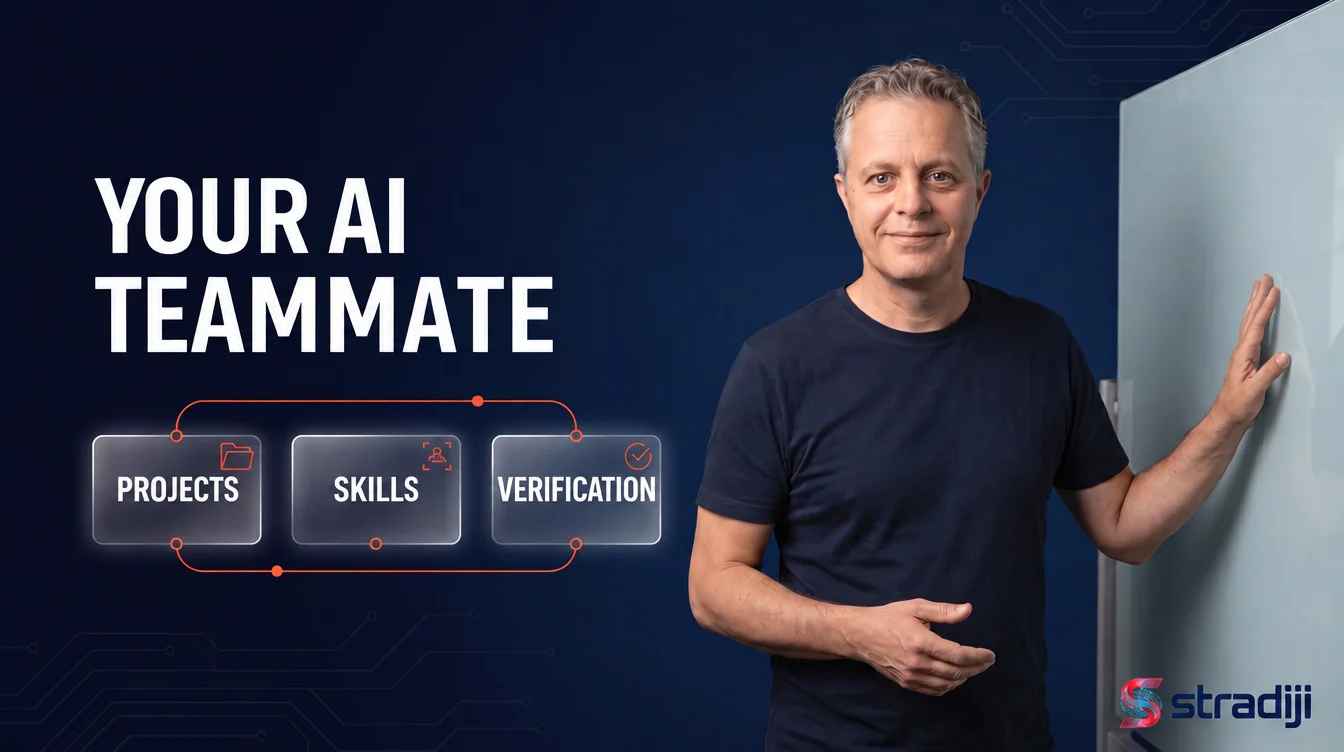
What your team gets
By the end, your team stops starting from a blank chat window and works inside a system that keeps its context.
Context that sticks
Each client or brand gets its own project. Claude rereads past decisions, meeting notes and open tasks every session.
Numbers from the source
With Search Console, GA4 and Semrush connected, every figure in a report comes from live data, not from the model's memory.
One dataset, three reports
The same weekly data becomes a version for executives, one for the technical team and one for marketing.
You stay in control
Every deliverable runs through a written checklist. Nothing reaches a client without human sign-off.
Chat windows don't scale
Most teams use AI as a chat window. Every conversation starts from zero, so you explain the client, the history and past decisions again and again. We worked that way too. Today each of our clients has its own Claude project, its own skill and its own project instructions.
| Chat window | AI teammate | |
|---|---|---|
| Context | Every conversation starts from zero. | The project keeps past decisions and notes. |
| Rules | Explained again every time. | Written once in a skill, applied every time. |
| Data | Copied and pasted, source unclear. | Read live from connections, source stated. |
| Mistakes | The same error comes back. | Logged as a lesson and added to the checklist. |
| Team | Everyone has their own method. | Shared projects, shared rules, scheduled tasks. |
The room, the rulebook, the manual
The system has three parts. Once your team knows what each one is for, the quality of the output stops depending on who wrote the prompt.
The project is the room
The client's SEO or GEO brief, dated meeting notes, your task tracker and live data connections live in one place. A short STATE file sums up open items and recent decisions, and Claude reads it first every session.
The skill is the rulebook
The test is simple: what changes every week goes in the project, what applies every time goes in the skill. Client profile, brand voice, scope and decisions made all live here.
The instructions are the manual
Project instructions tell Claude what to read first, how to check its own work and what it must never do.
We don't write the first skill. We let Claude interview us. We hand it the brief, the proposal, the kickoff notes and the latest audit, and we tell it to mark gaps as "[ASK ME]" instead of guessing. After about 20 minutes of questions, the skill beats anything we'd write from scratch.
Mert Erkal, founder of Stradiji
What you'll learn
Six modules. Every example comes from your own data and your own recurring work.
Setup
We set up Claude Cowork, your first project and its instructions, and write your first STATE file together.
Your first skill
We build a client skill from your brief by letting Claude interview you, including a "decisions made" section.
Live connections
We connect Search Console, GA4, Semrush and your task tracker. For tools without a connector, Claude in Chrome steps in.
One report, three versions
Five lines for executives, URLs and priorities for the technical team, wins and next content for marketing.
Verification and learning loop
Checklists, a dated lessons log and push-back prompts, so a mistake gets fixed once and written into the system.
Team rhythm
We set up scheduled tasks and approval rules. A human always stays in the loop.
Our advice: Start small and boring. One client, one task, every day for two weeks.
The verification loop
Every deliverable type has a written checklist. Claude runs it in a "checker" role and ends with a line like "Verification: 9/9 passed." That's a check before human review, not proof that everything is right.
When Claude gets something wrong, we fix the system, not just the output. A lesson isn't learned until it's written in three places:
Pick the path that fits
Learning on your own? Start with the newsletter. Want a working system for your team, built on your data? That's the team program.
The SEOs Diners Club newsletter
A free weekly newsletter on SEO, GEO and AI search. It's where we share what we test in our own workflow first.
- Weekly analysis: What changed in search and AI answers, and what it means for your site.
- Our own data: Studies and tests we run on real sites, with the method shown.
- Workflow notes: How we use Claude in client work, including what didn't work.
A program built for your team
For marketing, SEO and content teams of 3 to 15 people. Not an off-the-shelf course: it's built around your work.
- Discovery: We map the tasks your team repeats every week, your tools and your data.
- GEO Score Card: We measure your site's AI search visibility with our GEO Score Card, so the training uses your own data.
- Workshop: We build your first project, skill and weekly report with your team. Online, scheduled in U.S.-friendly hours.
- Follow-up: We run the checklist and lessons log with you for the first two weeks.
Who it's for
A good fit if
- Your team rebuilds the same report, plan or recap every week
- Your agency loses context as the client list grows
- You've tried AI but it never became part of how the team works
Not a fit if
- You want a one-off prompt-writing class
- You need classic SEO training: see Corporate SEO Training or our GEO consulting service

Mert Erkal
Mert Erkal has worked in SEO since 2009 and founded Stradiji in 2010. Based in Istanbul, Türkiye, he advises enterprise brands in the U.S., the U.K. and Australia on SEO, generative engine optimization (GEO) and conversion optimization.
He writes the weekly newsletter The SEOs Diners Club. His AI training and certifications are listed on his LinkedIn profile. See every tool we use on our tool stack page.
Frequently asked questions
What is Claude Cowork?
It's a workspace where Claude carries out multistep work for you, using your files, connected tools and scheduled tasks. Unlike a chat window, it keeps context inside a project and hands back finished work.
Do we need to code?
No. The training is built entirely around marketing and SEO work.
Which Claude plan do we need?
Pro, Max or Team all work. Pro is enough to start on your own; we recommend Max for teams that use Claude heavily every day. We decide together during discovery.
Is client data safe?
Each client's data stays in its own project, and projects never mix. Every client-facing output gets human review.
Which tool do you teach?
Only Claude Cowork, the tool we use for our own client work every day.
Do you work with teams outside the U.S.?
Yes. Workshops run online, and we schedule them around your time zone.
Request a quote for your team
Pricing is tailored to your team after a 30-minute discovery call.
I read every request myself and reply within one business day.
Mert Erkal